
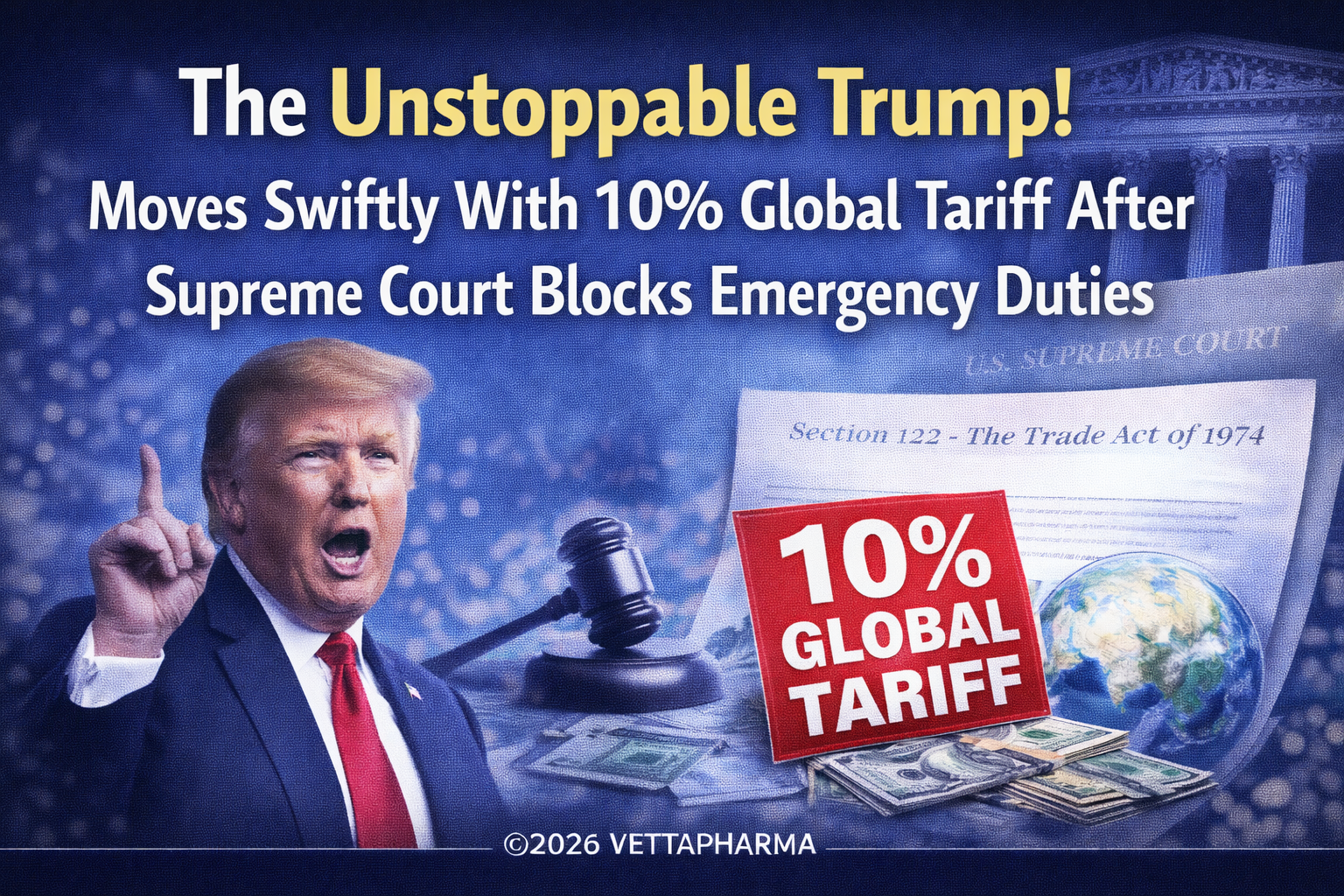
By VETTAPHARMA reporter – Derek Roche: Within hours of the U.S. Supreme Court’s February 20, 2026 ruling that invalidated his sweeping global tariffs imposed under the International Emergency Economic Powers Act (IEEPA), former President Donald Trump announced a fresh trade measure — a temporary 10% global tariff on imports under Section 122 of the Trade Act of 1974.
The Supreme Court, in a 6–3 decision, held that IEEPA did not grant the president unilateral authority to impose broad-based tariffs, reaffirming that tariff-setting powers rest with Congress. The ruling dismantled the emergency tariff framework that had shaped U.S. trade policy over the past year.
Immediate Executive Action
Trump invoked Section 122 — a separate statutory mechanism — to introduce a 10% across-the-board tariff for 150 days, describing it as a temporary safeguard while pursuing broader trade restructuring. Section 122 allows the president to impose temporary tariffs without prior congressional approval, but only for a limited duration.
The move signaled that while the Court curtailed executive authority under IEEPA, the administration was prepared to use alternative legal pathways to maintain tariff leverage.
Escalation Rather Than Retreat
Reports in Indian media indicate that Trump framed the new tariff as a “reset” of global trade terms, maintaining pressure on key trading partners even after the judicial setback. Analysts described the development as a shift in legal strategy rather than a reversal of trade policy. For the previous coverage on this topic read here
Although the Supreme Court ruling reduced the effective trade-weighted average U.S. tariff rate, the new 10% measure partially offsets that reduction, sustaining uncertainty for exporters worldwide.
Broader Trade Strategy
The administration is also reviewing the potential use of other trade authorities, including Section 301 (unfair trade practices) and Section 232 (national security tariffs), which remain legally intact despite the Supreme Court decision. This keeps open the possibility of targeted tariffs on specific sectors in the coming months.
The rapid reintroduction of tariffs underscores a continued commitment to a protectionist trade agenda. Trade experts note that while the Court’s decision curbs the use of emergency powers, it does not eliminate broader statutory tools available to the executive branch.
Global and Indian Perspective
Indian trade officials and exporters are closely monitoring developments, as the 10% temporary tariff could affect multiple export categories depending on implementation details. While pharmaceuticals and certain critical sectors may see exemptions, clarity is still evolving.
The sequence of events suggests that the Supreme Court verdict has not ended tariff-driven trade policy. Instead, it has prompted a re-calibration of the legal foundation through which such policies are implemented.

