
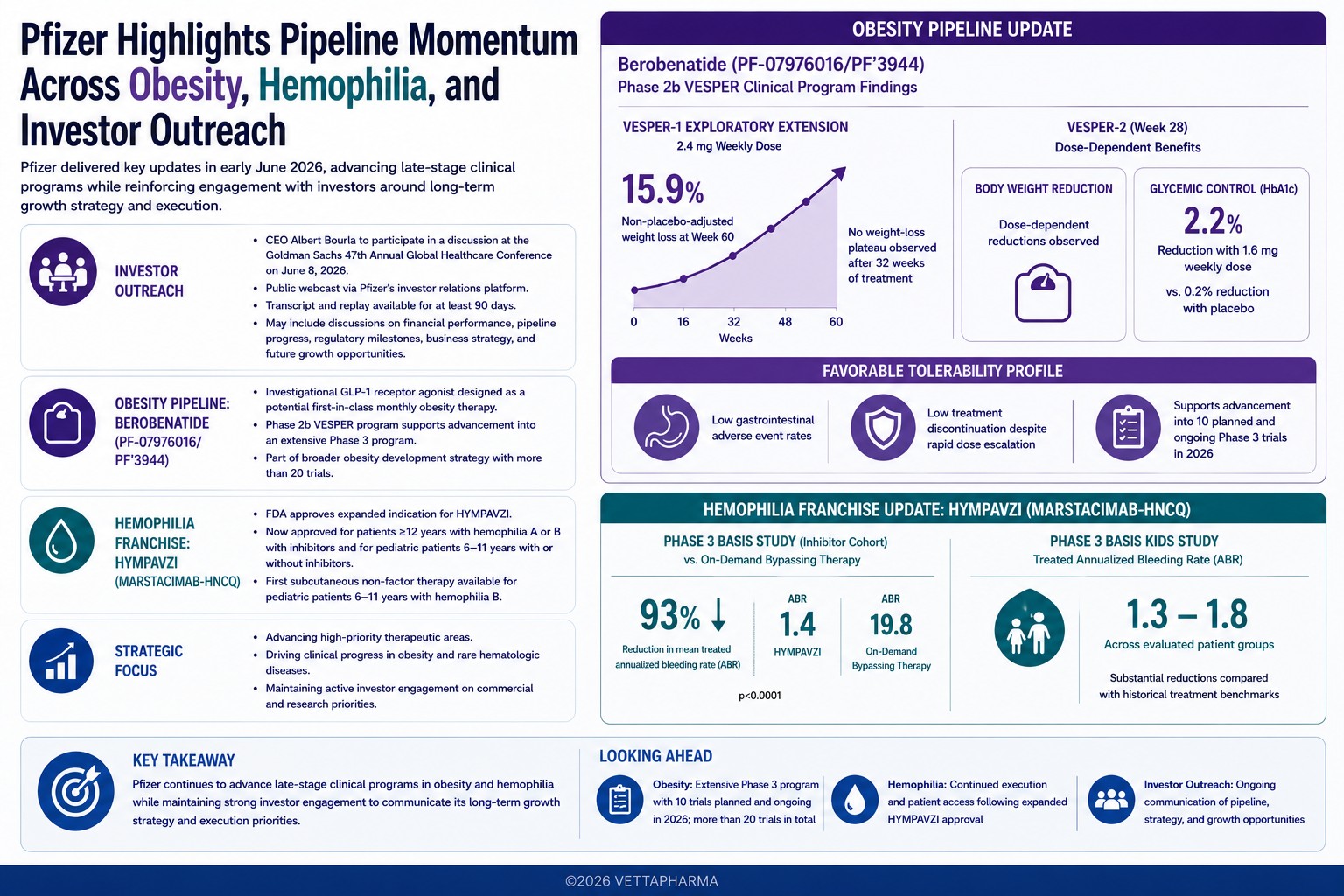
By VETTAPHARMA Reporter – Derek Roche: Pfizer delivered a series of updates in early June 2026 spanning its obesity pipeline, hemophilia franchise, and investor engagement activities, underscoring the company’s continued focus on advancing late-stage clinical programs while communicating its long-term growth strategy to stakeholders.
The company announced that Chairman and Chief Executive Officer Albert Bourla would participate in a discussion at the Goldman Sachs 47th Annual Global Healthcare Conference on June 8, 2026. The event was scheduled to be webcast publicly through Pfizer’s investor relations platform, with a transcript and replay expected to remain available for at least 90 days following the live session. The webcast may include discussions related to Pfizer’s financial performance, pipeline progress, regulatory milestones, business strategy, and future growth opportunities.
On the clinical development front, Pfizer reported detailed Phase 2b findings for berobenatide (PF-07976016/PF’3944), an investigational GLP-1 receptor agonist being developed as a potential first-in-class monthly obesity therapy. Results from the VESPER clinical program showed that participants in the VESPER-1 exploratory extension achieved a non-placebo-adjusted weight loss of 15.9% at Week 60, with no weight-loss plateau observed after 32 weeks of treatment on the 2.4 mg weekly dose. The company stated that the Phase 2b studies supported advancement into an extensive Phase 3 program that includes 10 planned and ongoing Phase 3 trials in 2026 and forms part of a broader obesity development strategy comprising more than 20 trials.
Pfizer also highlighted favorable tolerability findings for berobenatide, including low gastrointestinal adverse event rates and low treatment discontinuation despite rapid dose escalation. The VESPER-2 study further demonstrated dose-dependent reductions in both body weight and glycemic control measures, including a 2.2% reduction in HbA1c at Week 28 with the 1.6 mg weekly dose compared with a 0.2% reduction in the placebo arm.
In hematology, Pfizer announced that the U.S. Food and Drug Administration approved an expanded indication for HYMPAVZI (marstacimab-hncq), extending use to patients aged 12 years and older with hemophilia A or B with inhibitors and to pediatric patients aged 6 to 11 years with or without inhibitors. The approval makes HYMPAVZI the first subcutaneous non-factor therapy available for pediatric patients aged 6 to 11 years with hemophilia B.
The expanded approval was supported by data from the Phase 3 BASIS and BASIS KIDS trials. In the inhibitor cohort of the BASIS study, HYMPAVZI reduced mean treated annualized bleeding rate (ABR) by 93%, achieving an ABR of 1.4 compared with 19.8 for on-demand bypassing therapy (p<0.0001). In the pediatric BASIS KIDS study, treated ABRs ranged from approximately 1.3 to 1.8 across evaluated patient groups, demonstrating substantial reductions compared with historical treatment benchmarks.
The updates collectively reinforce Pfizer’s strategy of advancing high-priority therapeutic areas, including obesity and rare hematologic diseases, while maintaining engagement with investors regarding its commercial and research priorities.
Quick FAQs
What Are Berobenatide and HYMPAVZI?
Berobenatide is an investigational GLP-1 receptor agonist being developed for obesity and obesity-related comorbidities, while HYMPAVZI (marstacimab-hncq) is an approved anti-TFPI therapy for routine prophylaxis in hemophilia A and B.
What Happened?
Pfizer announced participation in the Goldman Sachs Healthcare Conference, presented Phase 2b obesity data for berobenatide, and reported FDA approval of an expanded indication for HYMPAVZI.
What Were the Key Berobenatide Results?
The VESPER-1 extension showed 15.9% non-placebo-adjusted weight loss at Week 60 without a plateau, while VESPER-2 demonstrated dose-dependent weight loss and HbA1c reductions, including a 2.2% HbA1c reduction at the 1.6 mg weekly dose.
What Did the FDA Approve for HYMPAVZI?
The FDA expanded HYMPAVZI’s indication to include patients aged 12 years and older with hemophilia A or B with inhibitors and children aged 6 to 11 years with or without inhibitors.
What Were the Key Hemophilia Trial Results?
In the BASIS trial, HYMPAVZI reduced mean treated annualized bleeding rate by 93% versus on-demand therapy, achieving an ABR of 1.4 compared with 19.8. Pediatric studies also demonstrated low treated bleeding rates across evaluated groups.
Why Is This Important?
The updates highlight Pfizer’s progress in two major growth areas—obesity and rare diseases—while providing investors with visibility into the company’s clinical, regulatory, and strategic priorities.

