
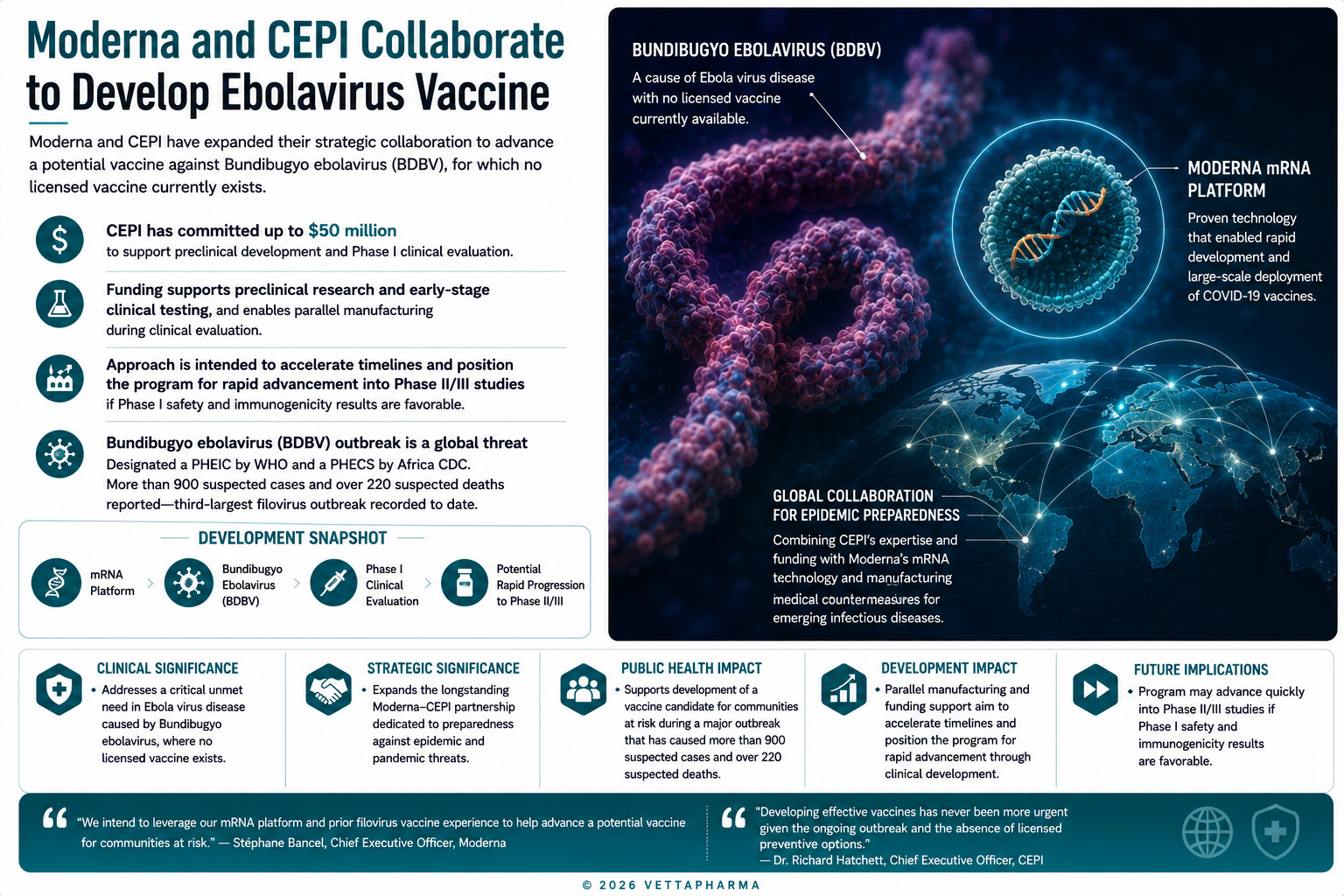
By VETTAPHARMA reporter – Derek Roche: Moderna reported an expansion of its strategic collaboration with the Coalition for Epidemic Preparedness Innovations (CEPI) to advance development of a potential vaccine against Bundibugyo ebolavirus (BDBV), a cause of Ebola virus disease for which no licensed vaccine currently exists. Under the agreement, CEPI has committed up to $50 million to support preclinical development and Phase I clinical evaluation of Moderna’s investigational vaccine candidate.
The funding will support both preclinical research and early-stage clinical testing, while also enabling parallel manufacturing activities. Moderna said this approach is intended to accelerate development timelines by allowing vaccine doses to be produced during clinical evaluation, positioning the program for potential rapid advancement into Phase II/III studies if Phase I safety and immunogenicity results are favorable.
The investigational vaccine is being developed using Moderna’s mRNA platform, the same technology that enabled rapid development and large-scale deployment of COVID-19 vaccines. The program also builds on the company’s prior research efforts involving filoviruses, the viral family that includes Ebola viruses.
The collaboration extends a longstanding relationship between Moderna and CEPI focused on preparedness against epidemic and pandemic threats. According to the companies, combining CEPI’s expertise and funding with Moderna’s mRNA technology and manufacturing infrastructure is intended to accelerate development of medical countermeasures for emerging infectious diseases.
The announcement comes amid a significant Bundibugyo ebolavirus outbreak that has been designated both a Public Health Emergency of International Concern (PHEIC) by the World Health Organization and a Public Health Emergency of Continental Security (PHECS) by the Africa Centres for Disease Control and Prevention. The outbreak has resulted in more than 900 suspected cases and over 220 suspected deaths, making it the third-largest filovirus outbreak recorded to date.
Moderna’s chief executive officer Stéphane Bancel stated that the company intends to leverage its mRNA platform and prior filovirus vaccine experience to help advance a potential vaccine candidate for communities at risk. CEPI Chief Executive Officer Dr. Richard Hatchett highlighted the urgency of developing effective vaccines given the ongoing outbreak and absence of licensed preventive options.
For global health stakeholders, the collaboration represents an effort to accelerate vaccine development against a high-priority epidemic threat. From a strategic perspective, the agreement further expands Moderna’s infectious disease portfolio while reinforcing the role of mRNA technology in rapid-response vaccine development for emerging pathogens.
Quick FAQs
1. What Is Bundibugyo Ebolavirus?
Bundibugyo ebolavirus (BDBV) is a species of Ebola virus that causes Ebola virus disease and has been associated with multiple outbreaks in Africa.
2. What Did Moderna Announce?
Moderna announced an expanded collaboration with CEPI to develop an investigational mRNA vaccine against Bundibugyo ebolavirus.
3. What Is the Planned Clinical Study?
The collaboration will support preclinical development and a Phase I clinical trial evaluating Moderna’s investigational BDBV vaccine candidate.
4. What Is Ebola Virus Disease?
Ebola virus disease is a severe and often fatal viral illness caused by viruses within the filovirus family, including Bundibugyo ebolavirus.
5. How Much Funding Is CEPI Providing?
CEPI has committed up to $50 million to support vaccine development, clinical evaluation, and manufacturing activities.
6. Why Is This Collaboration Important?
The program aims to accelerate development of a vaccine against a virus responsible for an ongoing outbreak that has caused more than 900 suspected cases and over 220 suspected deaths.

