
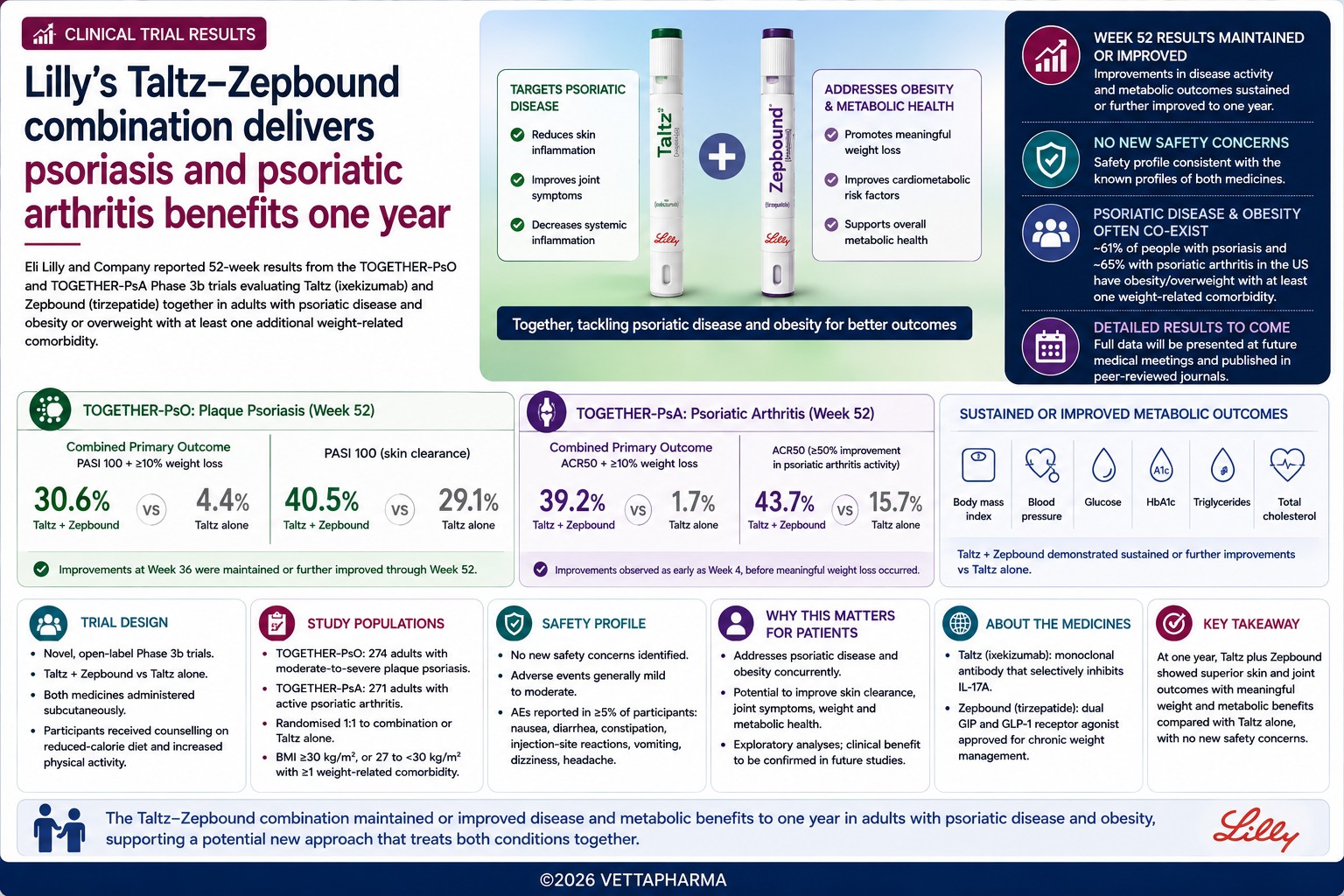
By VETTAPHARMA reporter – Derek Roche: Eli Lilly and Company reported 52-week results from the TOGETHER-PsO and TOGETHER-PsA Phase 3b trials evaluating Taltz (ixekizumab) and Zepbound (tirzepatide) together in adults with psoriatic disease and obesity or overweight with at least one additional weight-related comorbidity. The results showed that improvements in disease activity and metabolic outcomes observed at Week 36 were maintained or further improved through Week 52, with no new safety concerns identified.
TOGETHER-PsO evaluated adults with moderate-to-severe plaque psoriasis, while TOGETHER-PsA evaluated adults with active psoriatic arthritis. Both were novel, open-label Phase 3b trials comparing concomitant Taltz and Zepbound with Taltz alone.
In TOGETHER-PsO, 30.6% of patients receiving Taltz plus Zepbound achieved the combined primary outcome of complete skin clearance, measured by PASI 100, and at least 10% weight loss at Week 52, compared with 4.4% receiving Taltz alone. The proportion achieving PASI 100 was 40.5% with the combination versus 29.1% with Taltz monotherapy.
In TOGETHER-PsA, 39.2% of patients receiving both medicines achieved at least a 50% reduction in psoriatic arthritis disease activity, measured by ACR50, together with at least 10% weight loss at Week 52, compared with 1.7% receiving Taltz alone. ACR50 alone was achieved by 43.7% of patients on the combination versus 15.7% on Taltz monotherapy.
The psoriatic arthritis improvements were observed as early as Week 4, before clinically meaningful weight loss occurred, according to Lilly. The company also reported that systemic inflammation, measured using high-sensitivity C-reactive protein (hsCRP), showed deeper improvements over time with the combination in both trials.
Metabolic outcomes including body mass index, blood pressure, glucose, HbA1c, triglycerides and total cholesterol were sustained or further improved with Taltz plus Zepbound compared with Taltz alone. The Week 52 analyses were pre-specified exploratory objectives without multiplicity control, and comparisons between timepoints were descriptive rather than statistically tested with multiplicity control.
TOGETHER-PsO enrolled 274 adults with moderate-to-severe plaque psoriasis, while TOGETHER-PsA enrolled 271 adults with active psoriatic arthritis. Participants were randomised 1:1 to receive Taltz alone or Taltz with Zepbound, with both medicines administered subcutaneously. Participants also received counselling on a reduced-calorie diet and increased physical activity.
Both studies enrolled adults with obesity or overweight and at least one additional weight-related comorbidity. Participants were required to have a body mass index of at least 30 kg/m², or 27 to less than 30 kg/m² with at least one weight-related comorbidity.
The safety findings did not identify new concerns. Adverse events with the combination were generally mild to moderate and consistent with the known safety profiles of the two medicines. Adverse events reported in at least 5% of participants included nausea, diarrhea, constipation, injection-site reactions, vomiting, dizziness and headache.
The findings address the overlap between psoriatic disease and metabolic dysfunction. Lilly noted that approximately 61% of people with psoriasis and 65% of people with psoriatic arthritis in the US also have obesity or overweight with at least one weight-related comorbidity. Mean baseline BMI was 39.2 in TOGETHER-PsO and 37.6 in TOGETHER-PsA.
For patients, the results point to a potential approach that addresses psoriatic disease and obesity concurrently rather than through separate treatment strategies. However, the reported Week 52 analyses are exploratory, and Lilly said detailed results will be presented at future medical meetings and published in peer-reviewed journals.
Taltz is a monoclonal antibody that selectively binds interleukin 17A and inhibits its interaction with the interleukin 17 receptor. Zepbound is a dual GIP and GLP-1 receptor agonist approved for obesity management and is also FDA-approved for adults with moderate-to-severe obstructive sleep apnea and obesity.
Quick FAQs
1. What is the disease condition?
The trials evaluated psoriatic disease, including plaque psoriasis and psoriatic arthritis, in adults who also had obesity or overweight with at least one weight-related comorbidity.
2. What is the study/trial?
TOGETHER-PsO and TOGETHER-PsA are randomised, multicentre, assessor-blinded, open-label Phase 3b trials evaluating Taltz plus Zepbound versus Taltz alone.
3. What did the combination achieve in psoriasis?
At Week 52, 30.6% achieved PASI 100 plus at least 10% weight loss with Taltz and Zepbound versus 4.4% with Taltz alone.
4. What did the combination achieve in psoriatic arthritis?
At Week 52, 39.2% achieved ACR50 plus at least 10% weight loss with the combination versus 1.7% with Taltz alone.
5. What metabolic benefits were reported?
BMI, blood pressure, glucose, HbA1c, triglycerides and total cholesterol were sustained or further improved with Taltz plus Zepbound versus Taltz alone.
6. Were there new safety concerns?
No new safety concerns were identified. Adverse events were generally mild to moderate and consistent with the known safety profiles of the medicines.

