
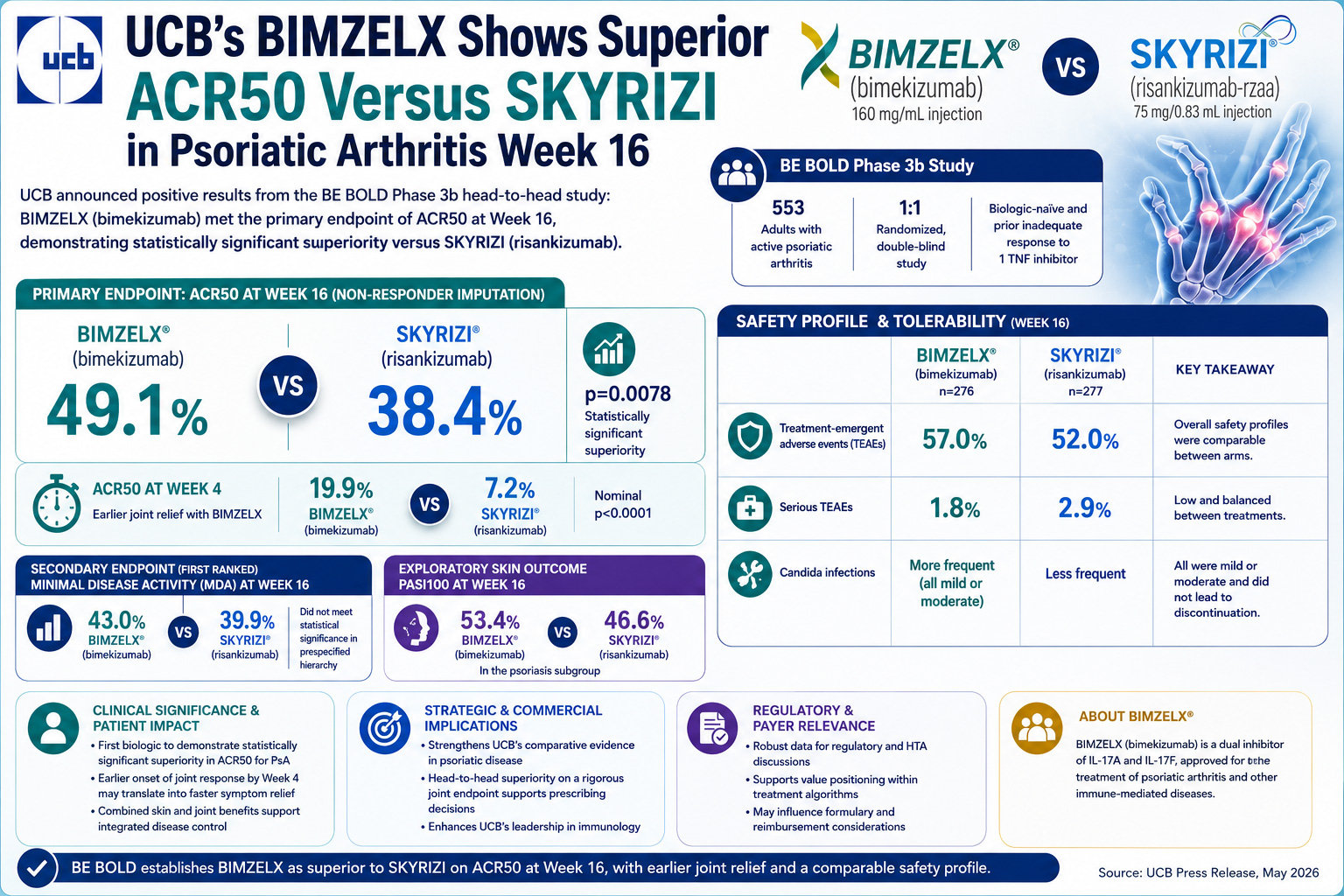
By VETTAPHARMA reporter – Derek Roche: UCB announced Week 16 results from the BE BOLD head‑to‑head Phase 3b study showing BIMZELX (bimekizumab) met the trial’s primary endpoint of ACR50 at Week 16, with 49.1% of bimekizumab‑treated patients achieving ACR50 versus 38.4% for SKYRIZI (risankizumab) (p=0.0078). The multicenter, randomized, double‑blind study enrolled 553 adults with active psoriatic arthritis, including biologic‑naïve patients and those with prior inadequate response to one TNF inhibitor.
Trial design and key efficacy outcomes: BE BOLD randomized participants 1:1 to bimekizumab or risankizumab and used non‑responder imputation for primary analyses. ACR50 at Week 4 favored bimekizumab (19.9% vs 7.2%; nominal p<0.0001), indicating earlier joint relief. The first ranked secondary endpoint, minimal disease activity (MDA) at Week 16, was 43.0% for bimekizumab versus 39.9% for risankizumab and did not meet statistical significance within the prespecified hierarchy. Exploratory skin outcomes showed PASI100 rates of 53.4% with bimekizumab and 46.6% with risankizumab in the psoriasis subgroup.
Safety profile and tolerability: Overall safety profiles were comparable between arms. Treatment‑emergent adverse events (TEAEs) occurred in 57.0% of bimekizumab patients versus 52.0% with risankizumab. Serious TEAEs were reported in 1.8% of bimekizumab recipients and 2.9% of risankizumab recipients. Candida infections were more frequent with bimekizumab; all were reported as mild or moderate and did not lead to discontinuation.
Clinical significance and patient impact: The head‑to‑head superiority in ACR50 establishes bimekizumab as the first approved biologic to demonstrate statistically significant superiority for this stringent joint endpoint in psoriatic arthritis. Earlier onset of joint response by Week 4 may translate into faster symptom relief and improved short‑term function for patients, while combined skin and joint benefits support integrated disease control for those with concomitant psoriasis.
Strategic and commercial implications: BE BOLD strengthens UCB’s comparative evidence base across psoriatic disease and may influence prescribing decisions where head‑to‑head data are valued. Demonstrated superiority on a rigorous joint endpoint positions BIMZELX competitively against IL‑23 inhibition and supports UCB’s broader immunology portfolio messaging at major congresses. The data also feed regulatory and payer discussions as UCB seeks to expand market uptake and justify positioning in treatment algorithms.

