
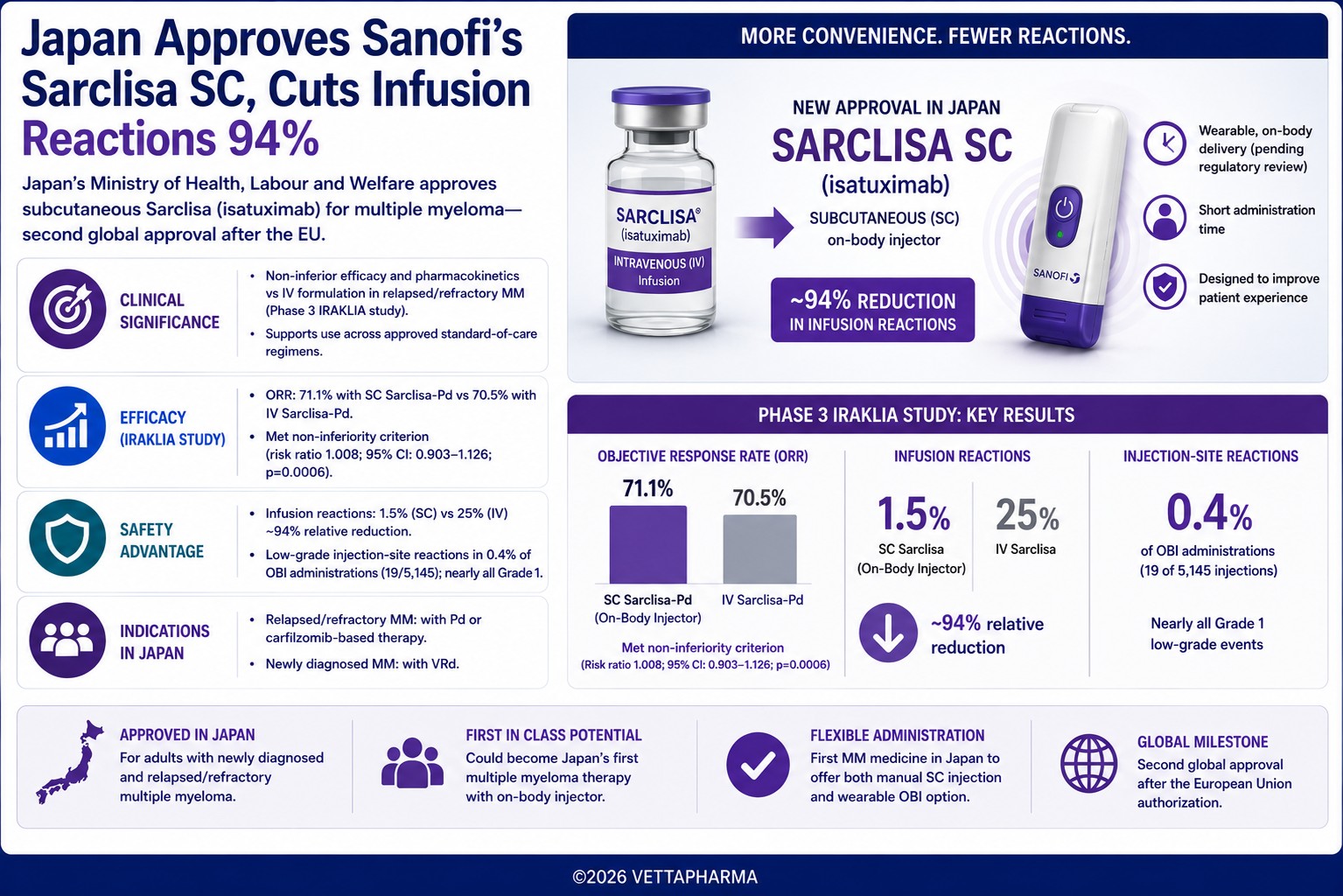
By VETTAPHARMA reporter – Derek Roche: Sanofi announced that Japan’s Ministry of Health, Labour and Welfare has approved the subcutaneous (SC) formulation of Sarclisa (isatuximab) for the treatment of multiple myeloma (MM), marking the second global approval for the formulation following its recent authorization in the European Union.
The approval covers use with approved standard-of-care regimens for newly diagnosed and relapsed or refractory multiple myeloma and could pave the way for Japan’s first oncology therapy administered through an on-body injector (OBI), pending a separate regulatory review.
The approval is supported by results from the pivotal Phase 3 IRAKLIA study (NCT05405166), which demonstrated that subcutaneous Sarclisa achieved non-inferior efficacy and pharmacokinetics compared with the intravenous (IV) formulation in adults with relapsed or refractory multiple myeloma who had received at least one prior line of therapy.
In the IRAKLIA trial, Sarclisa SC administered with pomalidomide and dexamethasone (Pd) via an on-body injector achieved an objective response rate (ORR) of 71.1%, compared with 70.5% for intravenous Sarclisa-Pd, meeting the predefined non-inferiority criterion (risk ratio 1.008; 95% CI: 0.903–1.126; p=0.0006).
The subcutaneous formulation also demonstrated a substantially lower rate of administration-related reactions. Infusion reactions occurred in 25% of patients receiving intravenous Sarclisa compared with 1.5% of patients receiving the subcutaneous formulation, representing an approximately 94% relative reduction. No new safety concerns were identified apart from low-grade injection-site reactions, which occurred in 0.4% of on-body injector administrations (19 of 5,145 injections), with nearly all events being Grade 1.
The approved indications in Japan include Sarclisa SC in combination with pomalidomide and dexamethasone (Pd) or carfilzomib-based therapy for relapsed or refractory multiple myeloma, and with bortezomib, lenalidomide and dexamethasone (VRd) for adults with newly diagnosed multiple myeloma. Separately, the CirCLIQ on-body injector, based on Enable Injections’ enFuse platform, remains under regulatory review. If approved, Sarclisa SC would become the first anticancer therapy administered via an on-body injector and the first multiple myeloma medicine in Japan to offer both manual subcutaneous injection and wearable on-body injector administration.
Quick FAQs
1. What Is Sarclisa?
Sarclisa (isatuximab) is an anti-CD38 monoclonal antibody approved for the treatment of newly diagnosed and relapsed or refractory multiple myeloma in combination with standard therapies.
2. What Happened?
Japan approved the subcutaneous formulation of Sarclisa for multiple myeloma, making it the second global approval after the European Union.
3. What Is The IRAKLIA Study?
IRAKLIA (NCT05405166) is a randomized, open-label Phase 3 study comparing fixed-dose subcutaneous Sarclisa administered via an on-body injector with weight-based intravenous Sarclisa, both combined with pomalidomide and dexamethasone, in adults with relapsed or refractory multiple myeloma.
4. What Is Multiple Myeloma?
Multiple myeloma is a cancer of plasma cells and is the third most common hematologic malignancy in Japan. Patients often require multiple lines of therapy as the disease progresses or relapses.
5. What Were The Key Results?
Sarclisa SC achieved a 71.1% ORR versus 70.5% with intravenous Sarclisa, demonstrated non-inferior efficacy, and reduced administration-related reactions from 25% with IV treatment to 1.5% with the subcutaneous formulation.
6. Why Is This Important?
The approval offers patients a more convenient subcutaneous treatment option while maintaining efficacy and reducing administration-related reactions. If the CirCLIQ on-body injector is approved, Sarclisa SC could become Japan’s first oncology therapy delivered through a wearable injector.

