
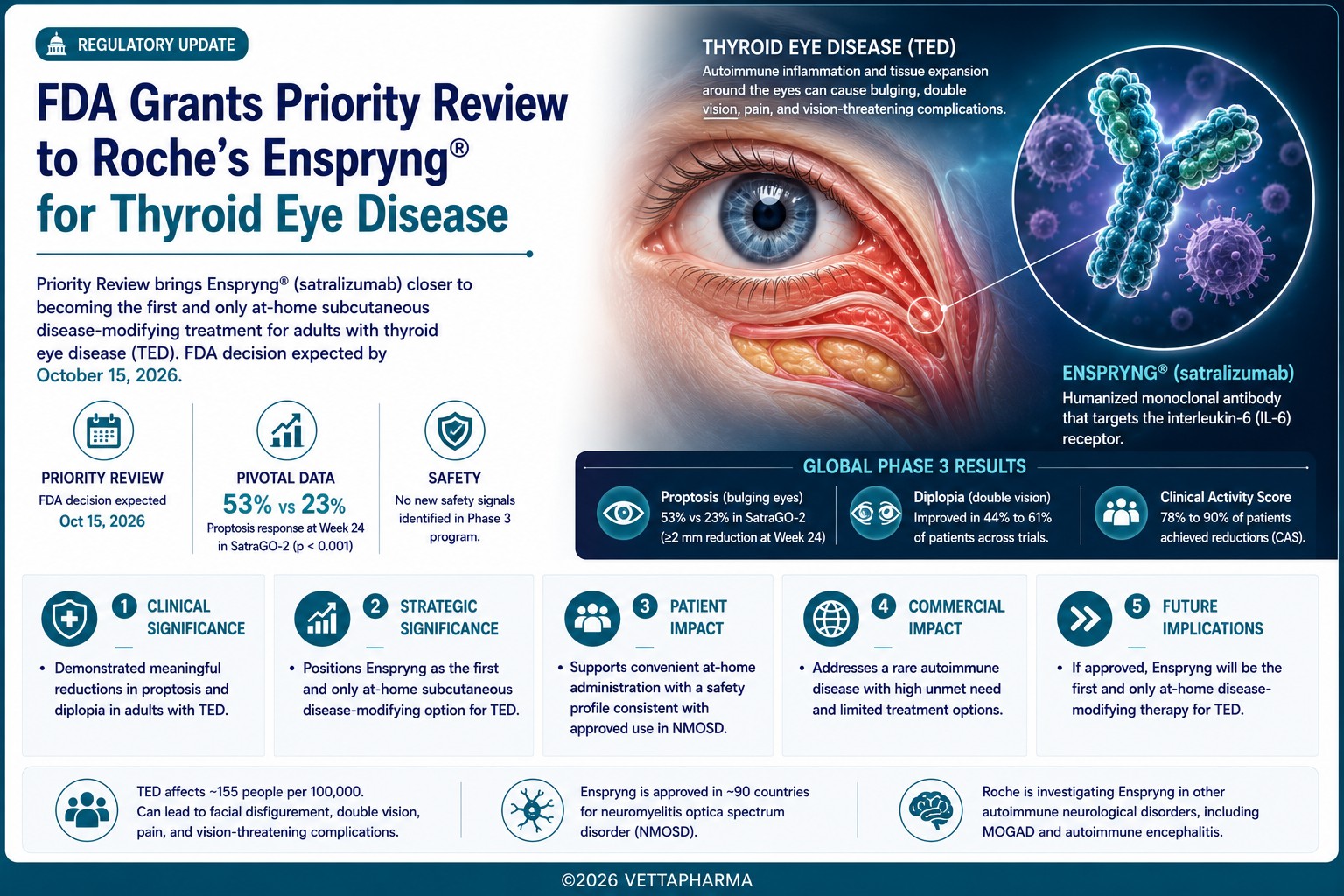
By VETTAPHARMA reporter – Derek Roche: The U.S. Food and Drug Administration (FDA) has granted Priority Review to Roche’s Enspryng® (satralizumab) for the treatment of thyroid eye disease (TED), bringing the therapy closer to becoming the first and only at-home subcutaneous disease-modifying treatment for adults with the condition.
The FDA is expected to make its regulatory decision by October 15, 2026.
The supplemental Biologics License Application (sBLA) is supported by results from the global Phase 3 SatraGO-1 (NCT05987423) and SatraGO-2 (NCT06106828) trials, which evaluated Enspryng in adults with active, moderate-to-severe and chronic inactive thyroid eye disease. Across the pivotal programme, Enspryng demonstrated clinically meaningful improvements in key disease manifestations, including proptosis (bulging eyes) and diplopia (double vision), while maintaining a safety profile consistent with its approved use in neuromyelitis optica spectrum disorder (NMOSD).
In SatraGO-2, 53% of patients receiving Enspryng achieved the primary endpoint of at least a 2 mm reduction in proptosis at Week 24, compared with 23% of patients receiving placebo, meeting statistical significance. In SatraGO-1, corresponding response rates were 49% versus 31%, demonstrating a numerical improvement that provided supportive evidence, although the study did not achieve statistical significance for the primary endpoint.
Enspryng also demonstrated consistent improvements across important secondary endpoints. Between 78% and 90% of patients experienced reductions in Clinical Activity Score (CAS), while improvements in diplopia were observed in 44% to 61% of patients across the two studies. No new safety signals were identified during the Phase 3 programme.
Thyroid eye disease is a rare autoimmune disorder affecting approximately 155 people per 100,000, causing inflammation and tissue expansion around the eyes that can lead to facial disfigurement, double vision, pain, and vision-threatening complications. Although treatment options are available, Roche noted that there remains a need for therapies that combine clinical efficacy with a favorable safety profile and convenient at-home administration.
Enspryng is a humanized monoclonal antibody that targets the interleukin-6 (IL-6) receptor and is currently approved in approximately 90 countries for neuromyelitis optica spectrum disorder. Roche is also investigating the therapy in several other autoimmune neurological disorders, including myelin oligodendrocyte glycoprotein antibody-associated disease (MOGAD) and autoimmune encephalitis.
Quick FAQs
1. What Is Enspryng?
Enspryng® (satralizumab) is a humanized monoclonal antibody that inhibits the IL-6 receptor and is currently approved for the treatment of neuromyelitis optica spectrum disorder (NMOSD).
2. What Happened?
The FDA granted Priority Review to Roche’s supplemental Biologics License Application for Enspryng to treat thyroid eye disease, with a regulatory decision expected by October 15, 2026.
3. What Studies Supported The Application?
The filing is supported by the global Phase 3 SatraGO-1 (NCT05987423) and SatraGO-2 (NCT06106828) randomized, placebo-controlled trials evaluating Enspryng in adults with thyroid eye disease.
4. What Is Thyroid Eye Disease?
Thyroid eye disease is a rare autoimmune disorder that causes inflammation of tissues around the eyes, leading to proptosis (bulging eyes), diplopia (double vision), pain, eyelid retraction, and potential vision loss.
5. What Were The Key Results?
In SatraGO-2, 53% of patients receiving Enspryng achieved at least a 2 mm reduction in proptosis at Week 24 compared with 23% receiving placebo. Improvements in Clinical Activity Score and diplopia were also observed across both Phase 3 trials, with no new safety signals identified.
6. Why Is This Important?
If approved, Enspryng would become the first and only at-home subcutaneous disease-modifying therapy for thyroid eye disease, potentially offering patients a more convenient treatment option while addressing the underlying inflammatory disease process.

