
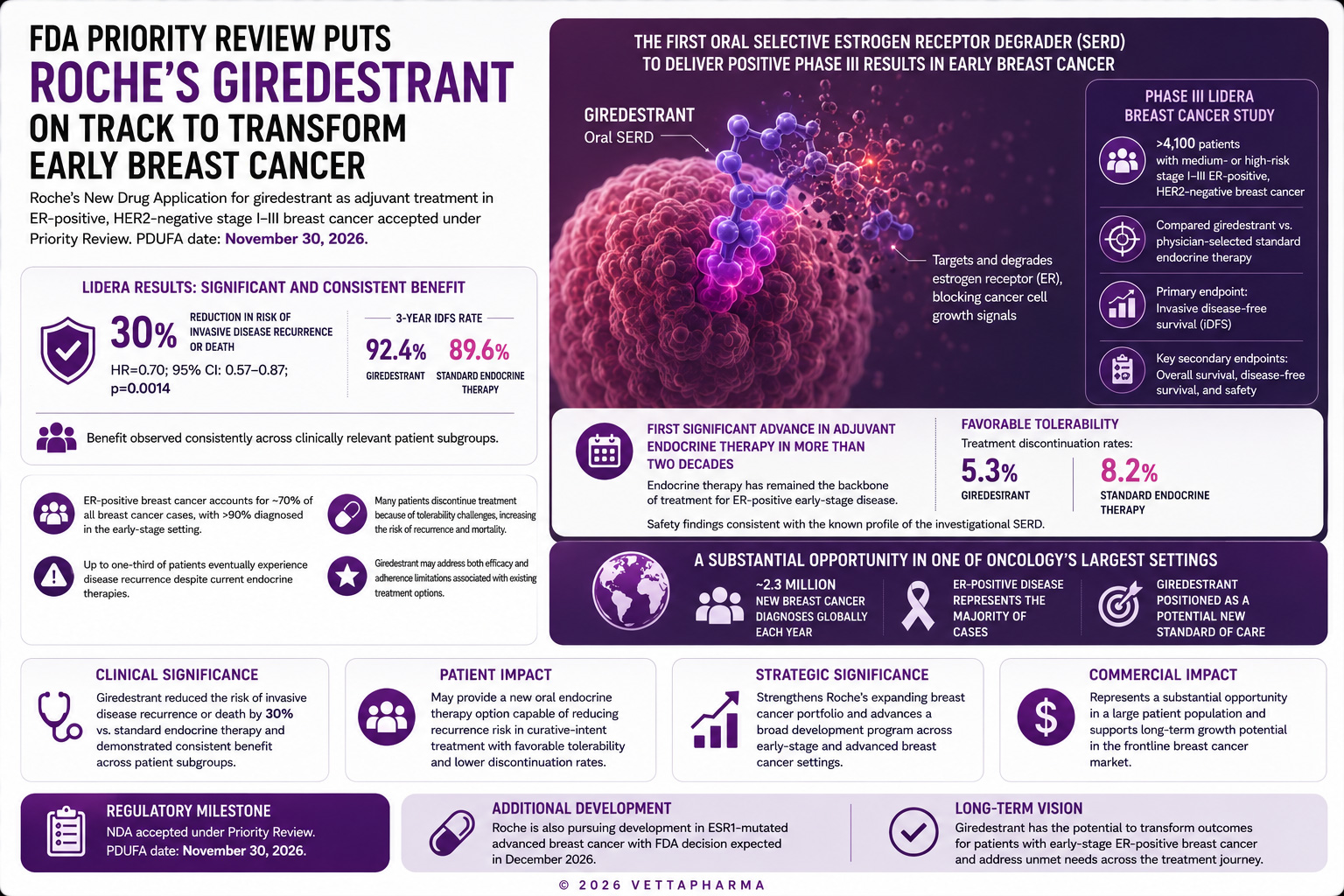
By VETTAPHARMA reporter – Derek Roche: Roche reported that the U.S. Food and Drug Administration (FDA) accepted the New Drug Application (NDA) for giredestrant under Priority Review as an adjuvant treatment for adults with estrogen receptor (ER)-positive, HER2-negative stage I-III breast cancer. The FDA assigned a Prescription Drug User Fee Act (PDUFA) date of November 30, 2026.
The filing is supported by results from the Phase III lidERA Breast Cancer study, in which giredestrant reduced the risk of invasive disease recurrence or death by 30% compared with standard-of-care endocrine therapy (HR=0.70; 95% CI: 0.57-0.87; p=0.0014). At three years, 92.4% of patients receiving giredestrant remained alive and free from invasive disease compared with 89.6% of patients receiving standard endocrine therapy. The benefit was observed consistently across clinically relevant patient subgroups.
Roche highlighted that giredestrant is the first and only oral selective estrogen receptor degrader (SERD) to demonstrate positive Phase III results in the curative early breast cancer setting. The company described the therapy as the first significant advance in adjuvant endocrine treatment in more than two decades, a period during which endocrine therapy has remained the backbone of treatment for ER-positive early-stage disease.
The Phase III lidERA Breast Cancer study enrolled more than 4,100 patients with medium- or high-risk stage I-III ER-positive, HER2-negative breast cancer. The trial compared adjuvant giredestrant with physician-selected standard endocrine therapy. The primary endpoint was invasive disease-free survival (iDFS), with key secondary endpoints including overall survival, disease-free survival, and safety.
Overall survival data remain immature, although Roche reported a positive trend at the time of analysis. The company also noted favorable tolerability, with treatment discontinuation rates of 5.3% for giredestrant versus 8.2% for standard endocrine therapy. Safety findings were consistent with the known profile of the investigational SERD.
ER-positive breast cancer accounts for approximately 70% of all breast cancer cases, with more than 90% diagnosed in the early-stage setting. Despite current endocrine therapies, up to one-third of patients eventually experience disease recurrence. Many patients also discontinue treatment because of tolerability challenges, increasing the risk of recurrence and mortality. Roche believes giredestrant may address both efficacy and adherence limitations associated with existing treatment options.
The filing acceptance further strengthens Roche’s expanding breast cancer portfolio and advances a broad clinical development program evaluating giredestrant across early-stage and advanced breast cancer settings. The company is simultaneously pursuing development in ESR1-mutated advanced breast cancer, where a separate FDA decision is expected in December 2026.
For patients, approval of giredestrant could introduce a new oral endocrine therapy option capable of reducing recurrence risk in curative-intent treatment. From a commercial perspective, the opportunity is substantial, with approximately 2.3 million new breast cancer diagnoses globally each year and ER-positive disease representing the majority of cases. Roche is positioning giredestrant as a potential new standard of care in one of oncology’s largest treatment settings.
Quick FAQs
1. What Is Giredestrant?
Giredestrant is an investigational oral selective estrogen receptor degrader (SERD) designed to block and degrade the estrogen receptor in breast cancer cells.
2. What Did Roche Announce?
Roche announced that the FDA accepted the NDA for giredestrant under Priority Review for ER-positive, HER2-negative early-stage breast cancer.
3. What Is the lidERA Breast Cancer Study?
lidERA is a Phase III trial evaluating adjuvant giredestrant versus standard endocrine therapy in more than 4,100 patients with medium- or high-risk stage I-III ER-positive, HER2-negative breast cancer.
4. What Is ER-Positive Breast Cancer?
ER-positive breast cancer is a subtype in which tumor cells express estrogen receptors that can drive cancer growth. It accounts for approximately 70% of breast cancer cases.
5. What Were the Key Phase III Results?
Giredestrant reduced the risk of invasive disease recurrence or death by 30% versus standard endocrine therapy, with 92.4% of patients remaining invasive disease-free at three years compared with 89.6% for standard treatment.
6. Why Is This Filing Important?
If approved, giredestrant could become the first oral SERD approved in the curative early breast cancer setting and potentially the first major advance in adjuvant endocrine therapy in more than 20 years.

