
By VETTAPHARMA reporter – Derek Roche: Boehringer Ingelheim has initiated three Phase 3 clinical trials to advance precision oncology in aggressive cancers with high unmet need, expanding late-stage development of its investigational therapies obrixtamig and zongertinib.
The trials span small cell lung cancer (SCLC), extrapulmonary neuroendocrine carcinoma (epNEC), and HER2 (ERBB2)-mutant non-small cell lung cancer (NSCLC), aiming to extend biomarker-informed treatment strategies across multiple cancers and earlier stages of disease.
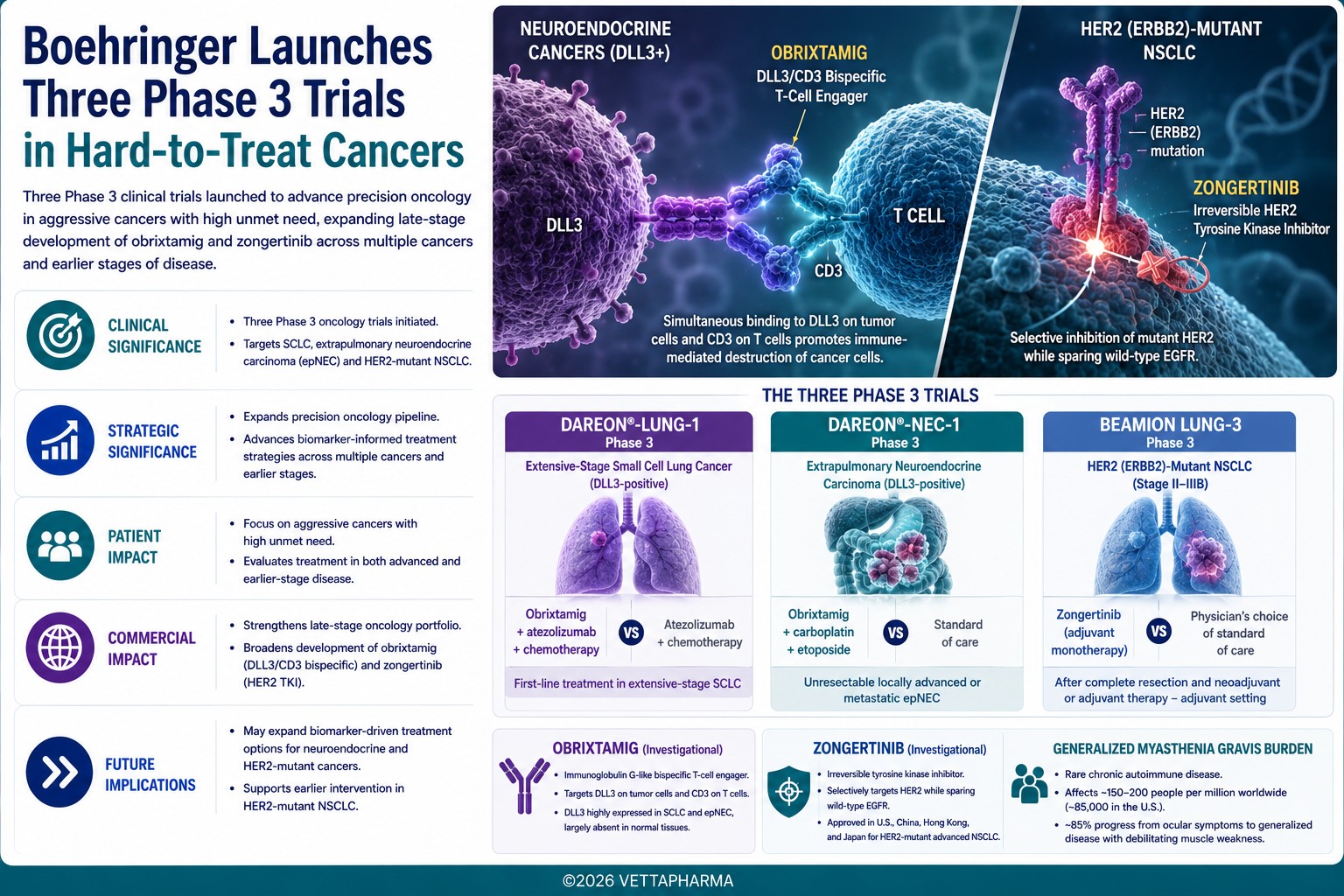
The company launched the DAREON®-Lung-1 and DAREON®-NEC-1 Phase 3 trials to evaluate obrixtamig, an investigational DLL3/CD3 bispecific T-cell engager, in patients with DLL3-positive neuroendocrine cancers. DAREON®-Lung-1 will compare obrixtamig plus atezolizumab and chemotherapy with atezolizumab plus chemotherapy as first-line treatment for extensive-stage small cell lung cancer, while DAREON®-NEC-1 will evaluate obrixtamig combined with carboplatin and etoposide versus standard of care alone in patients with DLL3-positive unresectable locally advanced or metastatic extrapulmonary neuroendocrine carcinoma.
Boehringer also initiated the Beamion LUNG-3 Phase 3 trial evaluating zongertinib as adjuvant monotherapy in patients with Stage II-IIIB HER2 (ERBB2)-mutant non-small cell lung cancer following complete surgical resection and neoadjuvant or adjuvant therapy. The global randomized study will assess whether zongertinib improves disease-free survival compared with physician’s choice of standard of care after surgery.
Obrixtamig is an investigational immunoglobulin G-like bispecific T-cell engager designed to simultaneously bind DLL3 on tumor cells and CD3 on T cells, promoting immune-mediated destruction of cancer cells. DLL3 is highly expressed in tumor cells from small cell lung cancer and extrapulmonary neuroendocrine carcinoma while being largely absent from normal tissues, making it a potential predictive biomarker for patient selection.
Zongertinib is an irreversible tyrosine kinase inhibitor that selectively targets HER2 while sparing wild-type EGFR. According to Boehringer, the therapy is already approved in the United States, China, Hong Kong, and Japan for adults with HER2 (ERBB2)-mutant advanced non-small cell lung cancer, while Beamion LUNG-3 extends its investigation into earlier-stage disease.
Quick FAQs
1. What Are Obrixtamig And Zongertinib?
Obrixtamig is an investigational DLL3/CD3 bispecific T-cell engager designed to target DLL3-positive tumors, while zongertinib is a selective HER2 tyrosine kinase inhibitor being evaluated across HER2-mutant cancers.
2. What Happened?
Boehringer Ingelheim initiated three Phase 3 clinical trials: DAREON®-Lung-1, DAREON®-NEC-1, and Beamion LUNG-3, advancing precision oncology in small cell lung cancer, extrapulmonary neuroendocrine carcinoma, and HER2-mutant non-small cell lung cancer.
3. What Are The Phase 3 Studies?
DAREON®-Lung-1 and DAREON®-NEC-1 are evaluating obrixtamig in biomarker-selected patients with aggressive neuroendocrine cancers, while Beamion LUNG-3 is evaluating adjuvant zongertinib versus standard of care in resectable Stage II-IIIB HER2-mutant non-small cell lung cancer.
4. What Cancers Are Being Studied?
The trials include extensive-stage small cell lung cancer, DLL3-positive extrapulmonary neuroendocrine carcinoma, and Stage II-IIIB HER2 (ERBB2)-mutant non-small cell lung cancer.
5. What Are The Primary Goals Of These Studies?
The DAREON trials aim to determine whether adding obrixtamig to standard therapy improves outcomes in biomarker-selected patients, while Beamion LUNG-3 is designed to evaluate whether zongertinib improves disease-free survival after curative-intent surgery.
6. Why Is This Important?
The three Phase 3 trials expand Boehringer Ingelheim’s precision oncology program by moving targeted therapies into late-stage development and earlier treatment settings, with the goal of improving outcomes for patients with aggressive cancers that currently have limited treatment options.

