
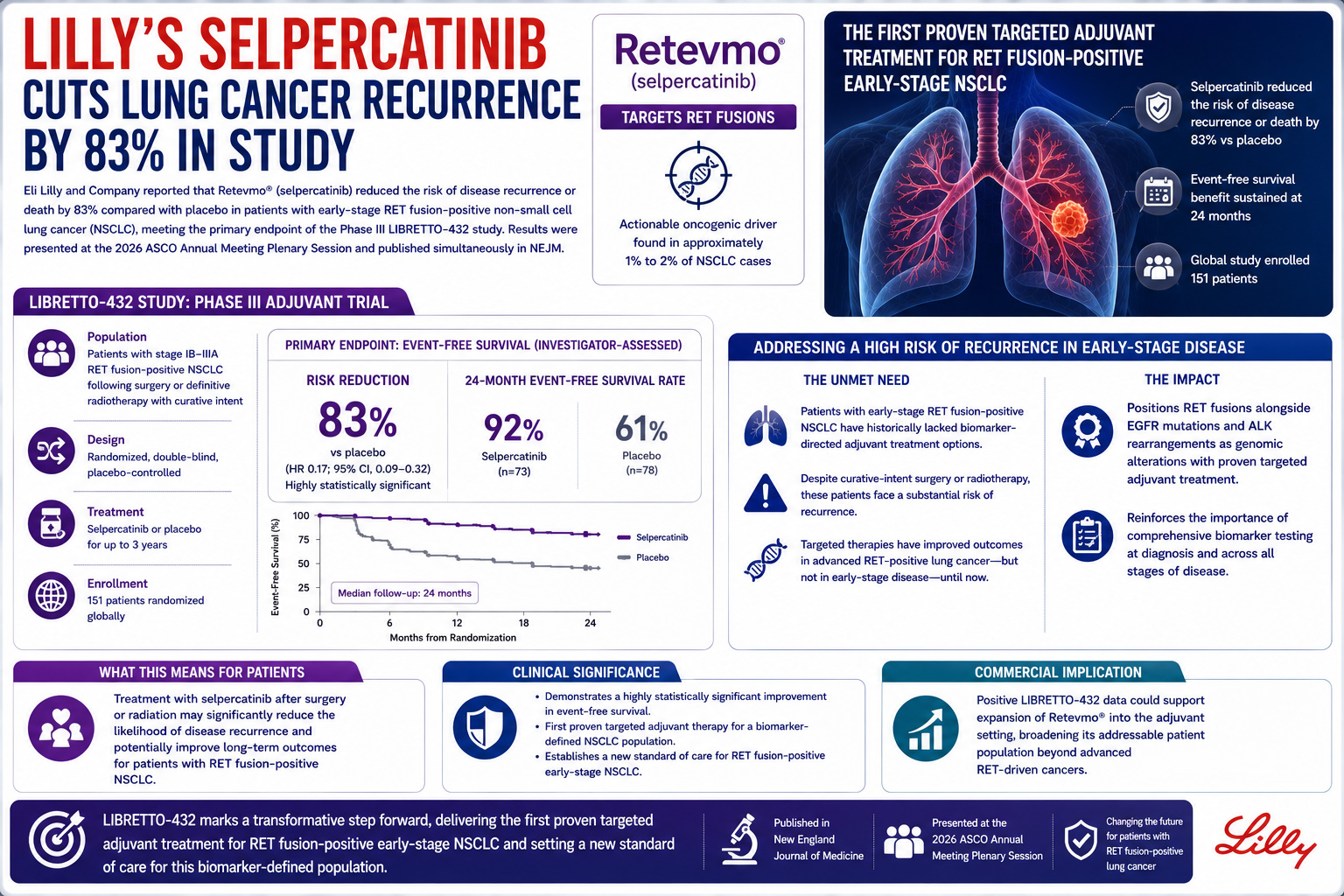
By VETTAPHARMA reporter – Derek Roche: Eli Lilly and Company reported that Retevmo (selpercatinib) reduced the risk of disease recurrence or death by 83% compared with placebo in patients with early-stage RET fusion-positive non-small cell lung cancer (NSCLC), meeting the primary endpoint of the Phase III LIBRETTO-432 study. The results were presented during the Plenary Session of the 2026 ASCO Annual Meeting and published simultaneously in the New England Journal of Medicine. The study evaluated selpercatinib as adjuvant therapy in patients with stage IB-IIIA RET fusion-positive NSCLC following surgery or definitive radiotherapy with curative intent. The trial demonstrated a highly statistically significant improvement in investigator-assessed event-free survival, establishing the first proven targeted adjuvant treatment approach for this biomarker-defined patient population.
At a median follow-up of 24 months, the 24-month event-free survival rate reached 92% for patients receiving selpercatinib compared with 61% for placebo. The global study enrolled 151 patients who were randomized to receive selpercatinib or placebo for up to three years.
RET fusions occur in approximately 1% to 2% of NSCLC cases and represent an actionable oncogenic driver. While targeted therapies have transformed outcomes in advanced RET-positive lung cancer, patients with early-stage disease have historically lacked biomarker-directed adjuvant treatment options despite a substantial risk of recurrence following curative-intent therapy.
The findings position RET fusions alongside EGFR mutations and ALK rearrangements as genomic alterations for which targeted adjuvant treatment can meaningfully improve outcomes in early-stage lung cancer. The data also reinforce the importance of comprehensive biomarker testing at diagnosis and across all stages of disease.
For patients, the results suggest that treatment with selpercatinib after surgery or radiation may significantly reduce the likelihood of disease recurrence and potentially improve long-term outcomes. From a commercial perspective, positive LIBRETTO-432 data could support expansion of Retevmo into the adjuvant setting, broadening its addressable patient population beyond advanced RET-driven cancers.
Quick FAQs
1. What is Retevmo?
Retevmo (selpercatinib) is a targeted RET kinase inhibitor approved for patients with RET-driven cancers.
2. What were the key LIBRETTO-432 results?
Selpercatinib reduced the risk of disease recurrence or death by 83% versus placebo in early-stage RET fusion-positive NSCLC.
3. What is the LIBRETTO-432 study?
LIBRETTO-432 is a Phase III trial evaluating adjuvant selpercatinib versus placebo in patients with stage IB-IIIA RET fusion-positive NSCLC following curative-intent treatment.
4. What is RET fusion-positive NSCLC?
It is a subtype of non-small cell lung cancer driven by RET gene fusions, which promote tumor growth and can be targeted with precision therapies.
5. What was the event-free survival rate at 24 months?
The 24-month event-free survival rate was 92% with selpercatinib compared with 61% with placebo.
6. Why are these results important?
The findings support the potential use of selpercatinib as the first targeted adjuvant therapy for patients with early-stage RET fusion-positive lung cancer.

