
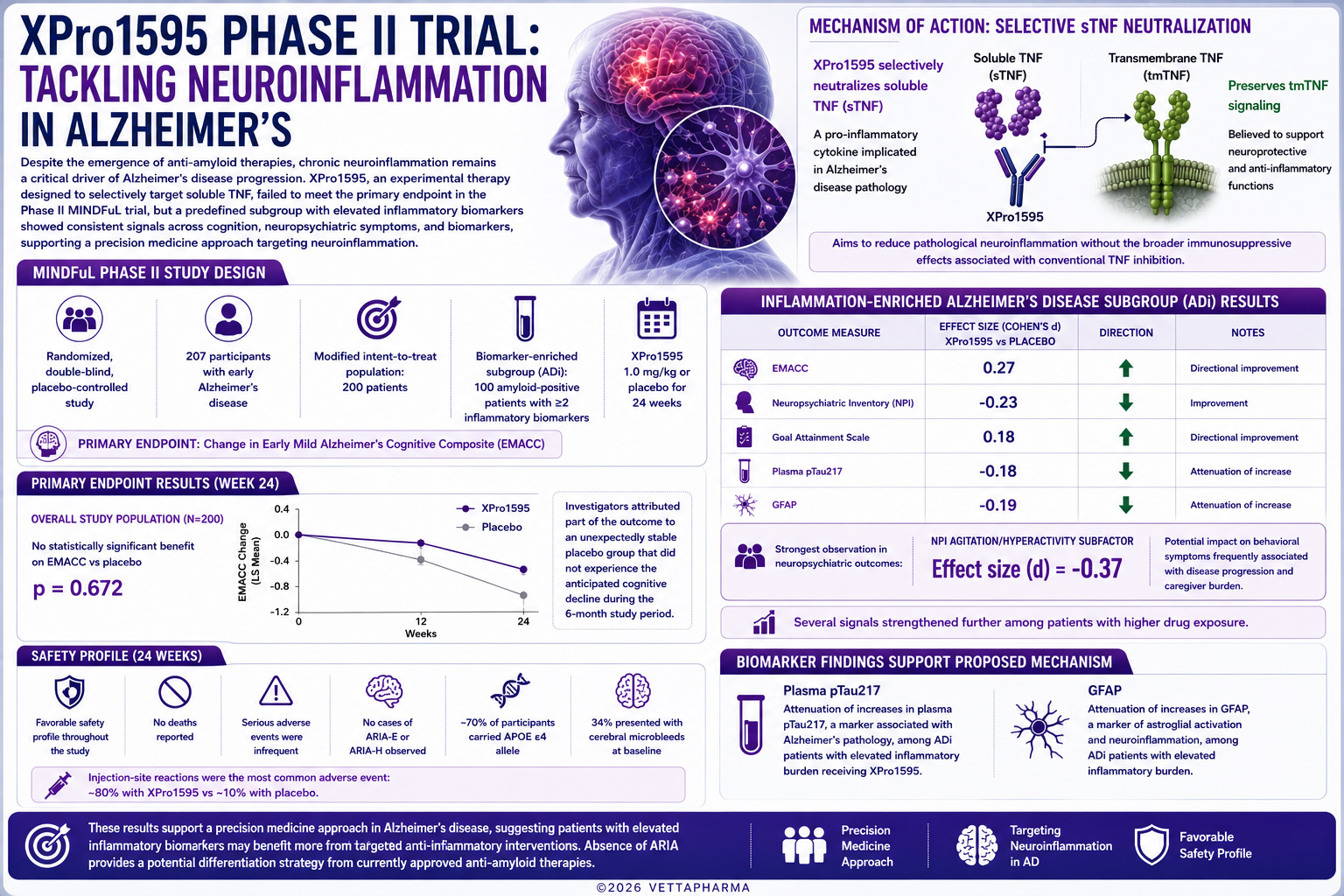
Despite the emergence of anti-amyloid therapies for Alzheimer’s disease, questions remain about how best to address the chronic neuroinflammation that accompanies disease progression. While recently approved treatments have demonstrated modest effects on cognitive decline, safety concerns and incomplete disease control continue to drive interest in alternative biological pathways. Against this backdrop, investigators evaluated XPro1595, an experimental therapy designed to selectively target soluble tumor necrosis factor (TNF), a key regulator of inflammatory signaling implicated in Alzheimer’s disease pathology. Researchers reported that XPro1595 failed to meet the primary endpoint in the Phase II MINDFuL trial in early Alzheimer’s disease, but a predefined subgroup of patients with elevated inflammatory biomarkers demonstrated consistent signals across cognition, neuropsychiatric symptoms, and disease-related biomarkers, supporting further investigation of a precision medicine approach targeting neuroinflammation.
The randomized, double-blind, placebo-controlled MINDFuL study enrolled 207 participants with early Alzheimer’s disease, including 200 patients in the modified intent-to-treat population and a biomarker-enriched subgroup of 100 amyloid-positive patients with at least two inflammatory biomarkers. Participants received XPro1595 at 1.0 mg/kg or placebo for 24 weeks. The primary endpoint was change in the Early Mild Alzheimer’s Cognitive Composite (EMACC).
In the overall study population, XPro1595 did not demonstrate a statistically significant benefit on EMACC versus placebo at Week 24 (p=0.672). Investigators attributed part of the outcome to an unexpectedly stable placebo group that did not experience the anticipated cognitive decline during the six-month study period.
The predefined inflammation-enriched Alzheimer’s disease subgroup (ADi) generated more encouraging findings. Patients receiving XPro1595 demonstrated directional improvements on EMACC (Cohen’s d=0.27), Neuropsychiatric Inventory (NPI; d=-0.23), Goal Attainment Scale (d=0.18), plasma pTau217 (d=-0.18), and glial fibrillary acidic protein (GFAP; d=-0.19) compared with placebo. Several signals strengthened further among patients with higher drug exposure.
One of the strongest observations emerged in neuropsychiatric outcomes. Within the ADi population, XPro1595 demonstrated an effect size of -0.37 on the NPI agitation/hyperactivity subfactor, suggesting a potential impact on behavioral symptoms frequently associated with disease progression and caregiver burden.
XPro1595 is designed to selectively neutralize soluble tumor necrosis factor (sTNF), a pro-inflammatory cytokine implicated in Alzheimer’s disease pathology, while preserving signaling through transmembrane TNF pathways believed to support neuroprotective and anti-inflammatory functions. The mechanism aims to reduce pathological neuroinflammation without the broader immunosuppressive effects associated with conventional TNF inhibition.
Biomarker findings supported the proposed mechanism. Investigators reported attenuation of increases in plasma pTau217, a marker associated with Alzheimer’s pathology, and GFAP, a marker of astroglial activation and neuroinflammation, among patients with elevated inflammatory burden receiving XPro1595.
The safety profile remained favorable throughout the 24-week treatment period. No deaths were reported, serious adverse events were infrequent, and no cases of amyloid-related imaging abnormalities (ARIA-E or ARIA-H) were observed despite approximately 70% of participants carrying the APOE ε4 allele and 34% presenting with cerebral microbleeds at baseline. Injection-site reactions represented the most common adverse event, occurring in approximately 80% of XPro1595-treated participants compared with 10% receiving placebo.
The findings support a growing precision medicine approach in Alzheimer’s disease, suggesting that patients with elevated inflammatory biomarkers may represent a biologically distinct population more likely to benefit from targeted anti-inflammatory interventions. The results also provide a potential differentiation strategy from currently approved anti-amyloid therapies, particularly given the absence of ARIA observed in the study.
Quick FAQs
1. What is XPro1595?
XPro1595 is an investigational biologic that selectively neutralizes soluble TNF to reduce neuroinflammation while preserving protective TNF signaling.
2. What were the key MINDFuL trial findings?
The study missed its primary endpoint in the overall population but demonstrated directional benefits across multiple outcomes in patients with elevated inflammatory biomarkers.
3. What is the study/trial?
MINDFuL is a Phase II randomized, double-blind, placebo-controlled trial evaluating XPro1595 in patients with early Alzheimer’s disease.
4. What is the disease condition?
Alzheimer’s disease is a progressive neurodegenerative disorder characterized by cognitive decline, memory impairment, behavioral symptoms, and loss of functional independence.
5. What were the most notable subgroup results?
The inflammation-enriched subgroup showed favorable signals on cognition, neuropsychiatric symptoms, pTau217, GFAP, and goal attainment measures.
6. Why is the safety profile important?
No cases of ARIA were observed, which may represent a potential advantage versus therapies associated with amyloid-related imaging abnormalities.
Source:
Jaeger, J., Staats, K. A., Barnum, S., Pope, P., Kingery, L., Buitendyk, M., Cohen, S., Tansey, M. G., Tesi, R. J., & Barnum, C. J. (2026). XPro1595 in early Alzheimer’s disease with inflammation: Results from the phase 2 MINDFuL trial. npj Dementia. https://doi.org/10.1038/s44400-026-00091-x

