
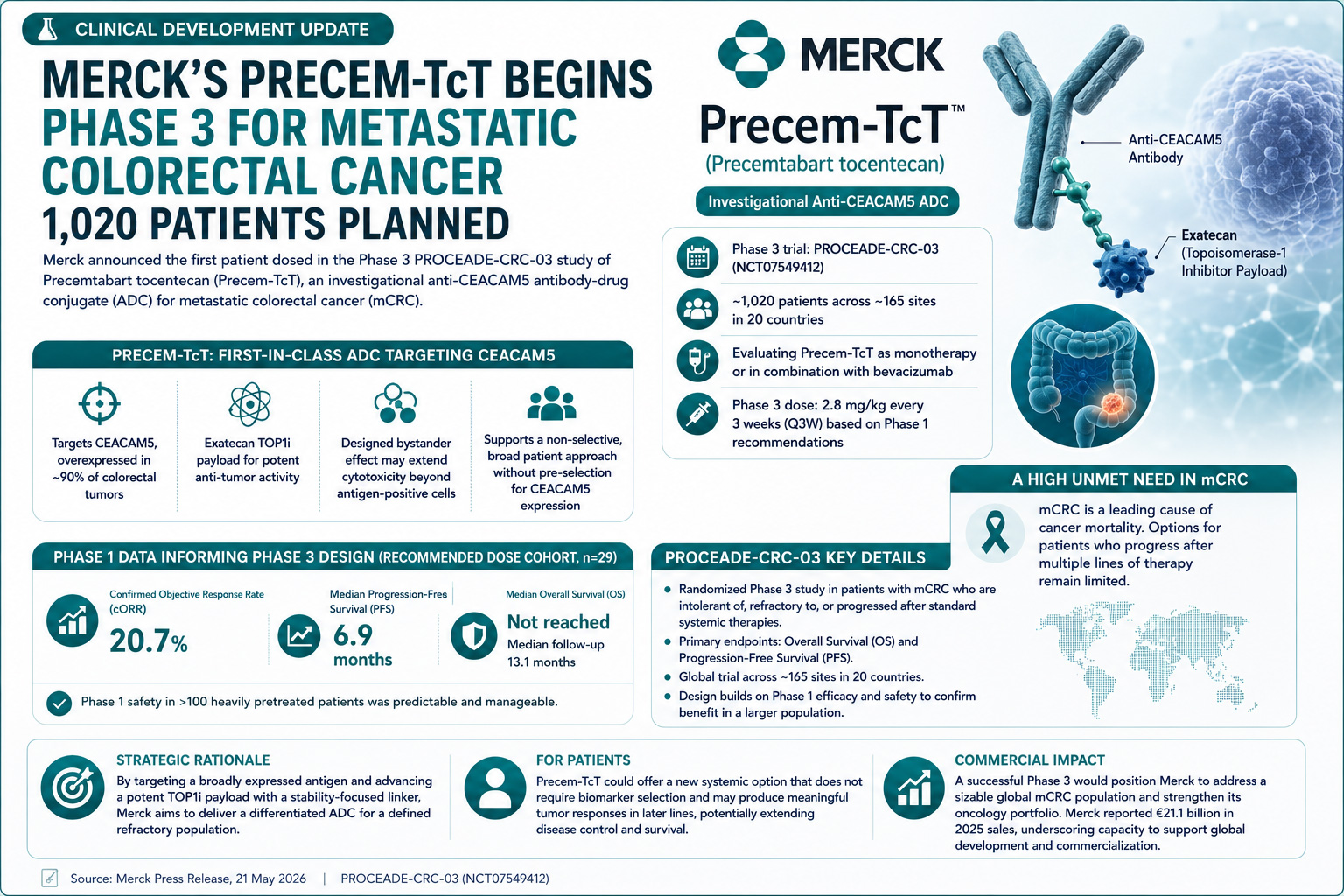
By VETTAPHARMA reporter – Derek Roche: Merck announced the first patient dosed in the Phase 3 PROCEADE‑CRC‑03 study of Precemtabart tocentecan (Precem‑TcT), an investigational anti‑CEACAM5 antibody‑drug conjugate (ADC) for metastatic colorectal cancer (mCRC). The milestone, reported 21 May 2026 from Darmstadt, advances a program designed for patients intolerant of, refractory to, or progressed after standard systemic therapies.
The randomized Phase 3 will enroll approximately 1,020 patients across ~165 sites in 20 countries and evaluate Precem‑TcT as monotherapy or in combination with bevacizumab. The trial identifier is PROCEADE‑CRC‑03 (NCT07549412) and the Phase 3 dose follows Phase 1 recommendations of 2.8 mg/kg every three weeks (Q3W).
Precem‑TcT is a first‑in‑class ADC targeting CEACAM5, a surface antigen overexpressed in ~90% of colorectal tumors, paired with an exatecan topoisomerase‑1 inhibitor payload. Merck highlights a designed bystander effect in the tumor microenvironment that may extend cytotoxicity beyond antigen‑positive cells, supporting a non‑selective, broad patient approach without pre‑selection for CEACAM5 expression.
Phase 1 data informed the Phase 3 design: in the recommended dose cohort (n=29) the confirmed objective response rate (cORR) was 20.7%, median progression‑free survival (PFS) 6.9 months, and median overall survival (OS) was not reached after a median follow‑up of 13.1 months. Phase 1 safety in more than 100 heavily pretreated patients was described as predictable and manageable, providing the basis for larger confirmatory testing.
Strategic rationale is clear: mCRC carries high unmet need—it is a leading cause of cancer mortality—and options for patients who progress after multiple lines remain limited. By targeting a broadly expressed antigen and advancing a potent TOP1i payload with a stability‑focused linker, Merck aims to deliver a differentiated ADC for a defined refractory population while leveraging its oncology development experience.
For patients, Precem‑TcT could offer a new systemic option that does not require biomarker selection and may produce meaningful tumor responses in later lines, potentially extending disease control and survival. Commercially, a successful Phase 3 would position Merck to address a sizable global mCRC population and strengthen its oncology portfolio; the company reported €21.1 billion in 2025 sales, underscoring capacity to support global development and commercialization.

