
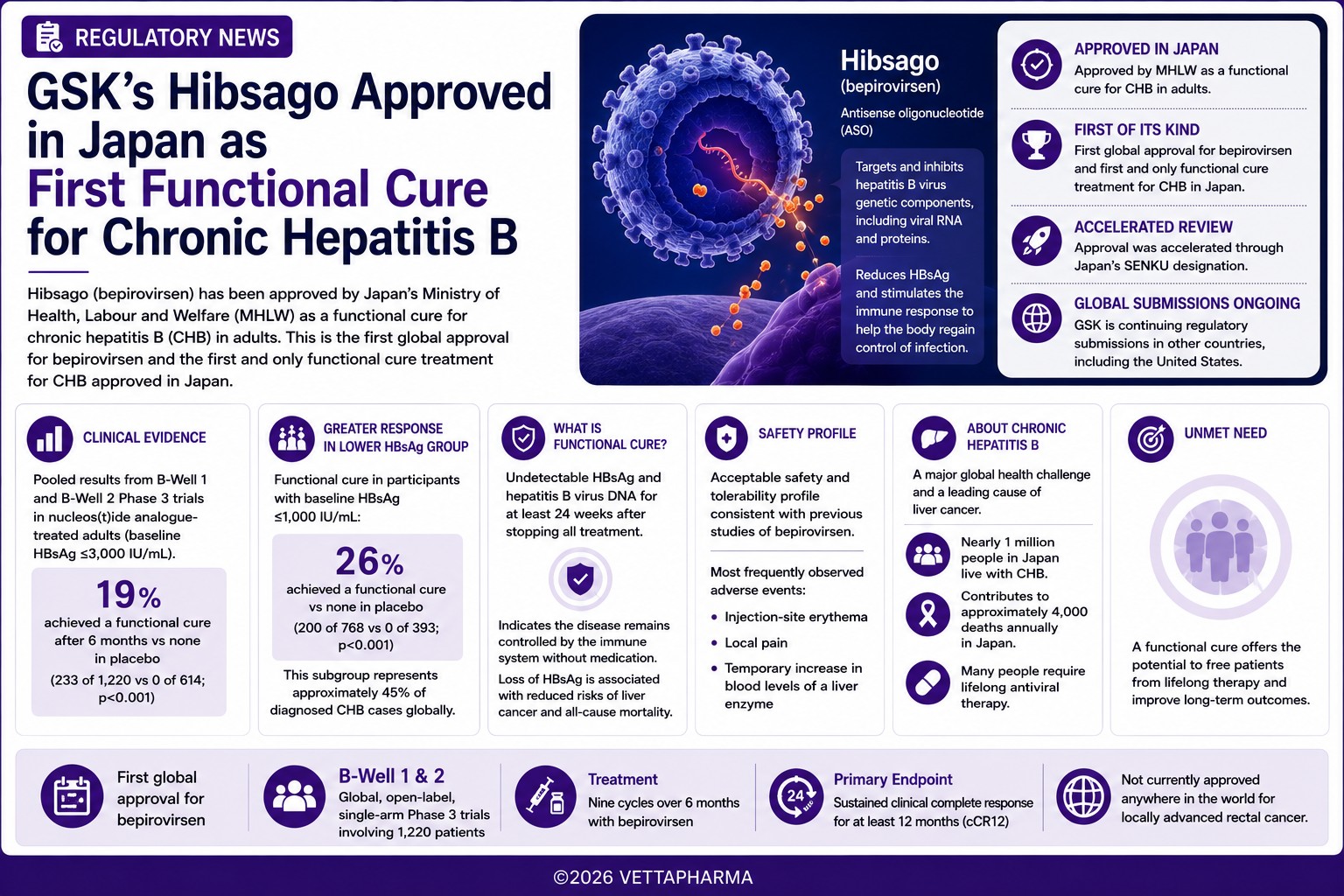
By VETTAPHARMA reporter – Derek Roche: GSK’s Hibsago (bepirovirsen) has been approved by Japan’s Ministry of Health, Labour and Welfare (MHLW) as a functional cure for chronic hepatitis B (CHB) in adults who have received at least six months of prior nucleos(t)ide analogue therapy and meet predefined viral marker criteria. The approval represents the first global approval for bepirovirsen and makes Hibsago the first and only functional cure treatment for CHB approved in Japan.
Hibsago is an antisense oligonucleotide (ASO) designed to target and inhibit the production of hepatitis B virus genetic components, including viral RNA and proteins. By reducing hepatitis B surface antigen (HBsAg) and stimulating the immune response, bepirovirsen is designed to help the immune system regain control of the infection.
The approval was supported by pooled results from the B-Well 1 and B-Well 2 Phase 3 trials, which evaluated bepirovirsen in nucleos(t)ide analogue-treated adults with CHB and baseline HBsAg levels of ≤3,000 IU/mL. After six months of treatment, 19% of participants achieved a functional cure, compared with none in the placebo group (233 of 1,220 vs 0 of 614; p<0.001), meeting the primary endpoint.
Functional cure was achieved in 26% of participants with baseline HBsAg levels of ≤1,000 IU/mL, compared with none in the placebo group (200 of 768 vs 0 of 393; p<0.001). This subgroup represents approximately 45% of diagnosed CHB cases globally.
Functional cure is defined as undetectable HBsAg and hepatitis B virus DNA for at least 24 weeks after stopping all treatment, indicating that the disease remains controlled by the immune system without medication. GSK noted that loss of HBsAg has been associated with reduced risks of liver cancer and all-cause mortality.
The B-Well trials reported an acceptable safety and tolerability profile consistent with previous studies of bepirovirsen. The most frequently observed adverse events were injection-site erythema, local pain, and a temporary increase in blood levels of a liver enzyme.
The approval was accelerated through Japan’s SENKU designation, which is granted to innovative medicines with potential to address high unmet medical needs. GSK is continuing regulatory submissions for bepirovirsen in other countries, including the United States.
Chronic hepatitis B is a major global health challenge and a leading cause of liver cancer. In Japan, nearly one million people live with CHB, with the disease contributing to approximately 4,000 deaths annually. Many people with CHB currently require lifelong antiviral therapy for viral suppression, making a functional cure an important goal in disease management.
Quick FAQs
1. What Is Hibsago?
Hibsago (bepirovirsen) is an antisense oligonucleotide designed to reduce the production of hepatitis B virus RNA and viral proteins and stimulate the immune system to help achieve sustained control of CHB without ongoing medication.
2. What Happened?
Japan’s MHLW approved Hibsago as a functional cure for chronic hepatitis B in eligible adults who have received at least six months of prior nucleos(t)ide analogue therapy.
3. What Studies Supported The Approval?
The approval was supported by the B-Well 1 and B-Well 2 Phase 3 trials, global randomized, double-blind, placebo-controlled studies conducted in 29 countries.
4. What Were The Key Results?
In participants with baseline HBsAg levels of ≤3,000 IU/mL, 19% achieved functional cure after six months of bepirovirsen treatment versus 0% with placebo. The rate increased to 26% among participants with baseline HBsAg levels of ≤1,000 IU/mL.
5. What Is A Functional Cure?
A functional cure is defined as HBsAg and hepatitis B virus DNA remaining undetectable for at least 24 weeks after stopping treatment, indicating that the immune system is controlling the disease without medication.
6. Why Is This Important?
Hibsago is the first globally approved treatment for functional cure of chronic hepatitis B and could potentially reduce the need for lifelong antiviral therapy in eligible patients.

