
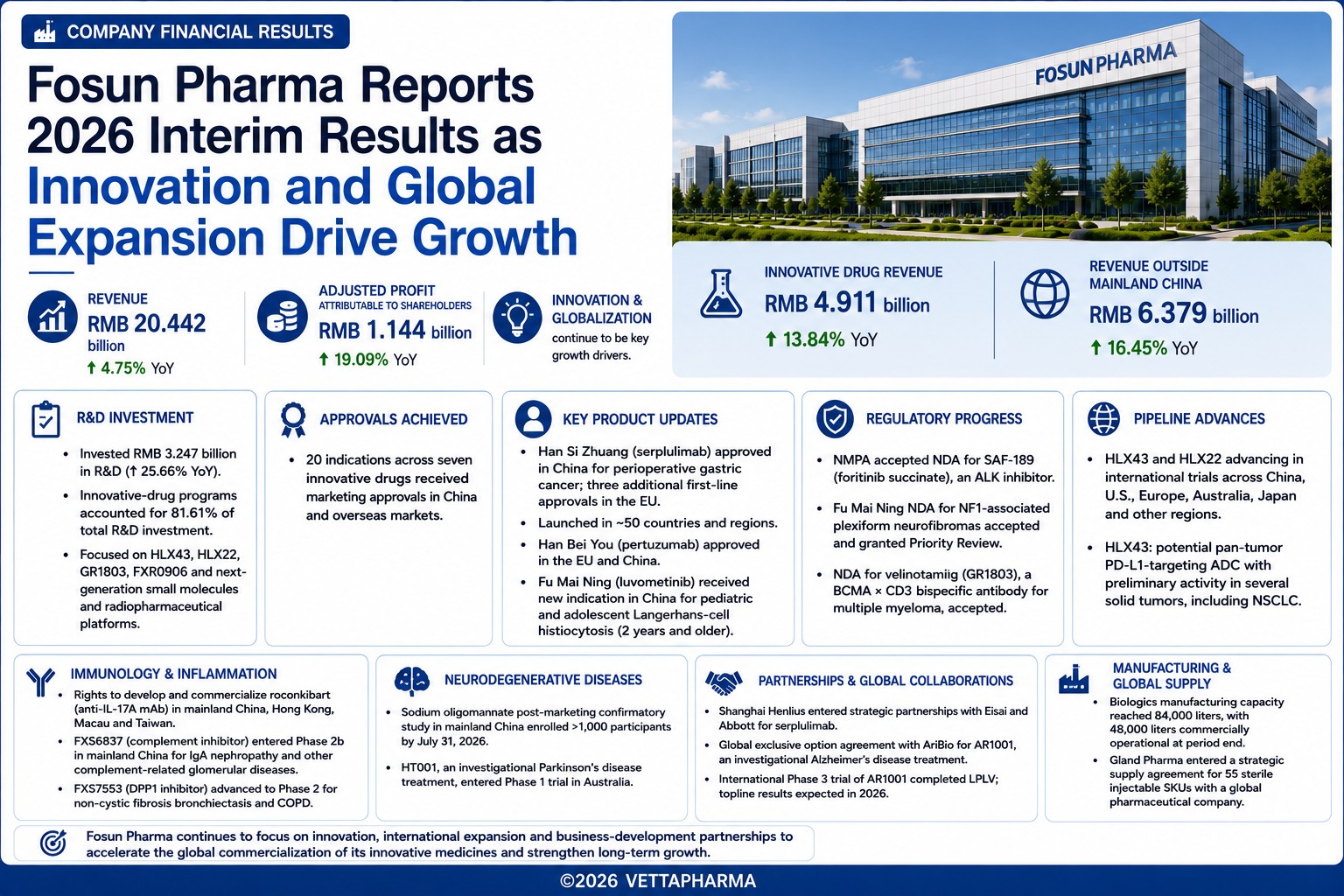
By VETTAPHARMA reporter – Derek Roche: Fosun Pharma reported revenue of RMB 20.442 billion for the first half of 2026, representing a 4.75% year-on-year increase, while adjusted profit attributable to shareholders rose 19.09% to RMB 1.144 billion. The company said innovation and globalization continued to serve as its key growth drivers.
Revenue from innovative drugs reached RMB 4.911 billion, up 13.84% year-on-year, while revenue from regions outside mainland China increased 16.45% to RMB 6.379 billion.
Fosun Pharma invested RMB 3.247 billion in research and development during the period, an increase of 25.66% year-on-year. Innovative-drug programs accounted for 81.61% of total R&D investment, with funding directed toward programs including HLX43, HLX22, GR1803 and FXR0906, as well as next-generation small molecules and radiopharmaceutical platforms.
During the first half of 2026, 20 indications across seven innovative drugs received marketing approvals in China and overseas markets.
Among the company’s key developments, Han Si Zhuang (serplulimab) received approval in China for perioperative treatment of gastric cancer and secured three additional first-line approvals in the European Union for squamous non-small-cell lung cancer, esophageal squamous-cell carcinoma and non-squamous non-small-cell lung cancer. Serplulimab has now been launched in approximately 50 countries and regions.
Han Bei You (pertuzumab) received successive marketing approvals in the European Union and China, while Fu Mai Ning (luvometinib) received a new indication in China for pediatric and adolescent patients aged 2 years and older with relapsed/refractory Langerhans-cell histiocytosis following systemic therapy.
The company also reported regulatory progress across its pipeline. The NMPA accepted the NDA for SAF-189 (foritinib succinate), an ALK inhibitor for non-small-cell lung cancer. The NDA for Fu Mai Ning in adults with symptomatic, inoperable plexiform neurofibromas associated with neurofibromatosis type 1 was accepted and granted Priority Review, while the NDA for velinotamig (GR1803), a BCMA × CD3 bispecific antibody for multiple myeloma, was accepted.
Fosun Pharma’s lead candidates HLX43 and HLX22 are advancing through international multicenter clinical trials across China, the United States, Europe, Australia, Japan and other regions. HLX43, described by the company as a potential pan-tumor PD-L1-targeting antibody-drug conjugate, has shown preliminary clinical activity across several solid tumors, including non-small-cell lung cancer.
In immunology and inflammation, Fosun Pharma obtained rights to develop, manufacture and commercialize roconkibart, an anti-IL-17A monoclonal antibody, in mainland China, Hong Kong, Macau and Taiwan. FXS6837, a complement inhibitor being investigated for immunoglobulin A nephropathy and other complement-related glomerular diseases, entered Phase 2b development in mainland China, while the DPP1 inhibitor FXS7553 advanced to Phase 2 development for non-cystic fibrosis bronchiectasis and chronic obstructive pulmonary disease.
The company is also expanding its neurodegenerative disease portfolio. The post-marketing confirmatory study of sodium oligomannate in mainland China had enrolled more than 1,000 participants by July 31, 2026, while HT001, an investigational Parkinson’s disease treatment, entered a Phase 1 trial in Australia.
Fosun Pharma continued to expand its international partnerships during the period. Its subsidiary Shanghai Henlius entered strategic partnerships with Eisai and Abbott for serplulimab. Separately, Fosun Pharma entered a global exclusive option agreement with AriBio for AR1001, an investigational Alzheimer’s disease treatment. The international Phase 3 trial of AR1001 has completed its last patient visit, with topline results expected in 2026.
The company also highlighted its manufacturing expansion and global supply capabilities. Its biologics manufacturing capacity reached 84,000 liters, of which 48,000 liters were commercially operational at the end of the reporting period. Its subsidiary Gland Pharma provides development and manufacturing capabilities for complex injectable products and recently entered a strategic supply agreement covering 55 sterile injectable SKUs with a global pharmaceutical company.
Fosun Pharma said its continued focus on innovation, international expansion and business-development partnerships is intended to accelerate the global commercialization of its innovative medicines and strengthen its long-term growth.
Quick FAQs
1. What Happened?
Fosun Pharma announced its 2026 interim results, reporting growth in revenue, profit and R&D investment while highlighting progress across its innovative-drug pipeline and international expansion.
2. How Did Revenue Perform?
First-half 2026 revenue was RMB 20.442 billion, up 4.75% year-on-year.
3. How Did Innovative Drugs Perform?
Innovative-drug revenue reached RMB 4.911 billion, representing a 13.84% year-on-year increase.
4. What Were The Key Regulatory Developments?
Seven innovative drugs received approvals covering 20 indications in China and overseas markets. Regulatory applications for SAF-189, Fu Mai Ning and velinotamig also advanced during the period.
5. Which Key Pipeline Programs Are Advancing?
Key programs include HLX43, HLX22, GR1803, FXR0906, FXS6837, FXS7553 and HT001, spanning oncology, immunology and inflammation, neurodegenerative diseases and other therapeutic areas.
6. What Is Driving Fosun Pharma’s Growth Strategy?
The company identifies innovation and globalization as its two core growth engines, supported by internal R&D, licensing partnerships, international clinical development, global commercialization and expanded manufacturing capabilities

