
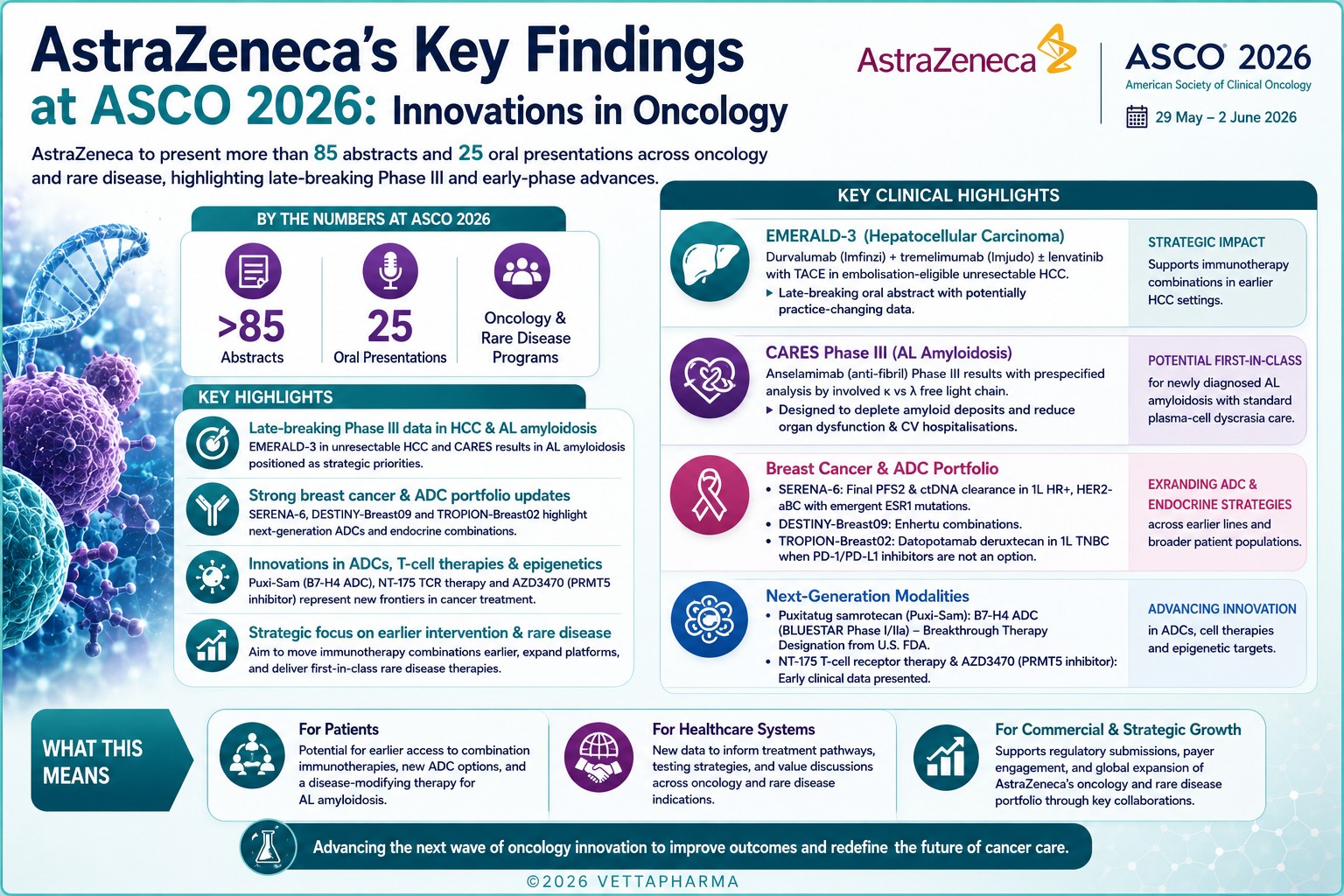
By VETTAPHARMA reporter – Derek Roche: AstraZeneca said it will showcase a broad slate of Phase III and early‑phase clinical data at the American Society of Clinical Oncology (ASCO) Annual Meeting, 29 May–2 June 2026, with more than 85 abstracts, 25 oral presentations, and results spanning oncology and rare disease programmes. The company highlighted late‑breaking Phase III findings from EMERALD‑3 (Imfinzi plus Imjudo with or without lenvatinib plus TACE in unresectable hepatocellular carcinoma) and the CARES Phase III programme of anselamimab for light‑chain (AL) amyloidosis, positioning both as strategic priorities for earlier intervention and rare‑disease innovation.
EMERALD‑3 is a randomized Phase III study evaluating durvalumab (Imfinzi) plus tremelimumab (Imjudo) with or without lenvatinib combined with transarterial chemoembolisation (TACE) in patients with embolisation‑eligible unresectable hepatocellular carcinoma. AstraZeneca listed EMERALD‑3 as a late‑breaking oral abstract, signalling potentially practice‑changing data for immunotherapy combinations in earlier HCC settings.
The CARES programme will present Phase III results for anselamimab, an anti‑fibril therapy from Alexion, AstraZeneca Rare Disease, including a prespecified subgroup analysis by involved kappa (κ) versus lambda (λ) free light chain. AstraZeneca framed CARES as a potential first‑in‑class approach designed to deplete amyloid deposits and reduce organ dysfunction and cardiovascular hospitalisations in newly diagnosed AL amyloidosis patients receiving standard plasma‑cell dyscrasia care.
Breast‑cancer and ADC portfolios feature prominently. SERENA‑6 will report final PFS2 and circulating tumour DNA clearance data for camizestrant plus CDK4/6 inhibitors in first‑line HR‑positive, HER2‑negative advanced breast cancer with emergent ESR1 mutations. Additional Phase III and exploratory analyses include DESTINY‑Breast09 (Enhertu combinations) and TROPION‑Breast02 (datopotamab deruxtecan as first‑line TNBC where PD‑1/PD‑L1 inhibitors are not an option).
AstraZeneca will also present updated safety and efficacy data for the B7‑H4 ADC puxitatug samrotecan (Puxi‑Sam) from the BLUESTAR Phase I/IIa programme; the molecule recently received Breakthrough Therapy Designation from the U.S. FDA in this setting. Early clinical data for novel modalities—NT‑175 T‑cell receptor therapy and the PRMT5 inhibitor AZD3470—are included, reflecting the company’s push into cell therapy and epigenetic targets.
AstraZeneca emphasised strategic aims to move immunotherapy combinations into earlier disease stages, expand ADC and T‑cell receptor platforms, and advance rare‑disease first‑in‑class candidates. For patients, the presentations could translate into earlier access to combination immunotherapies, new targeted ADC options, and a potential disease‑modifying therapy for AL amyloidosis. Commercially, the dataset supports ongoing collaborations (including with Daiichi Sankyo on Enhertu and Datroway), regulatory filings, and payer discussions as AstraZeneca seeks to broaden indications across oncology and rare disease.

